About Course
The Rubik’s Cube is a globally renowned 3D puzzle that challenges minds and dexterity. Invented by Ernő Rubik, this iconic cube consists of six faces adorned with colorful stickers, which players twist and turn to mix up the colors. The objective is to restore the cube to its original configuration, with each face showing a single color. Solving the Rubik’s Cube requires logic, spatial awareness, and problem-solving skills, making it a beloved pastime and brain-teasing challenge for enthusiasts of all age.
About Winquest
The Rubik’s Cube is a globally renowned 3D puzzle that challenges minds and dexterity. Invented by Ernő Rubik, this iconic cube consists of six faces adorned with colorful stickers, which players twist and turn to mix up the colors. The objective is to restore the cube to its original configuration, with each face showing a single color. Solving the Rubik’s Cube requires logic, spatial awareness, and problem-solving skills, making it a beloved pastime and brain-teasing challenge for enthusiasts of all age
Course Content
2×2 Cube
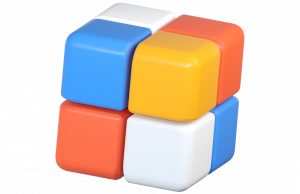
A 2×2 cube, often referred to as the “2×2 Rubik’s Cube,” “Pocket Cube,” or “Mini Cube,” is a smaller and simpler version of the classic 3×3 Rubik’s Cube puzzle. It is a three-dimensional mechanical puzzle that consists of smaller cubes, also known as “cubies,” arranged in a 2x2x2 configuration. Unlike the 3×3 cube, which has 6 faces and 54 stickers, the 2×2 cube has only 4 faces and 24 stickers.
Age group: 6+
Duration: 5 sessions
Requirements
- Stable internet connection
- Device to connect to the session
- 2×2 cube
Prerequisites
| Units |
Description |
| Lesson 1: Introduction |
– Introduce the 2×2 Rubik’s Cube and its basic mechanics.
– Explain the goal: to have all sides of the cube with the same color.
– Show them the different sides and colors of the cube. |
| Lesson 2: Solving the First Layer |
– Teach kids how to solve the first layer (one color) intuitively.
– Start with the white face since it’s the easiest to recognize.
– Show them how to make a white cross on the white face. |
| Lesson 3: Completing the First Layer |
– Continue from Lesson 2 to teach them how to complete the first layer.
– Explain how to align the corners correctly.
– Ensure they understand the process through hands-on practice. |
| Lesson 4: Solving the Opposite Layer |
– Introduce solving the opposite layer (the layer below the solved layer).
– Teach them how to intuitively match the colors and solve it layer by layer. |
| Lesson 5: Review and Speed |
– Review the entire solving process with the kids.
– Encourage them to practice regularly and try to improve their solving time.
– Provide tips on improving their speed, like finger tricks and efficient moves. |
3×3 Cube
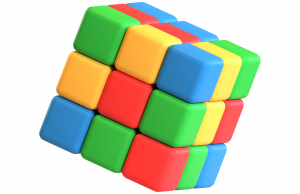
A 3×3 cube, commonly known as the “3×3 Rubik’s Cube” or simply the “Rubik’s Cube,” is the standard three-dimensional mechanical puzzle. It consists of a cube with six faces, each made up of nine smaller squares called “cubies.” The puzzle is characterized by its colorful stickers on each face, which can be of various colors but traditionally include white, yellow, blue, green, red, and orange.
Age group: 7+
Duration: 7 sessions
Requirements
- Stable internet connection
- Device to connect to the session
- 3×3 cube
Prerequisites
- Knowledge of solving a 2×2 cube recommended.
| Units |
Description |
| Lesson 1: Cube Familiarization |
– Introduction to the 3×3 Rubik’s Cube
– Understanding the cube’s structure and colors
– Basic cube terminology |
| Lesson 2: Solving the First Layer |
– Solving the first layer cross
– Completing the first layer corners
– Basic cube terminology |
| Lesson 3: Second Layer |
– Understanding and solving the second layer |
| Lesson 4: Solving the Third Layer Edges |
– Solving the third layer edges
– Introduction to the concept of algorithms |
| Lesson 5: Third Layer Corners |
– Solving the third layer corners
– Introduction to more advanced algorithms |
4×4 Cube
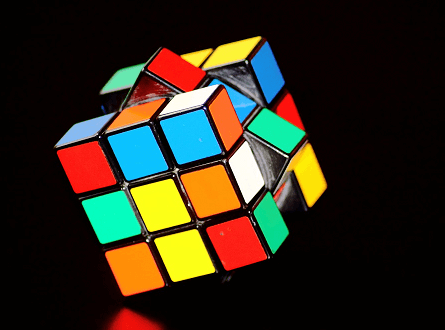
A 4×4 cube, often referred to as the “4×4 Rubik’s Cube” or “Rubik’s Revenge,” is a larger and more complex mechanical puzzle than the traditional 3×3 Rubik’s Cube. Like the 3×3 cube, it consists of a cube-shaped structure made up of smaller cubies, but it is larger and has more features. The 4×4 cube has four layers on each axis, meaning it has a total of 16 smaller squares on each face, making a total of 96 individual stickers. Unlike the 3×3 cube, the 4×4 cube has a mechanism that allows each of the four center cubies on each face to rotate independently, adding an extra layer of complexity to the puzzle.













































Reviews
There are no reviews yet.