


Course Details
Mathematics Grade 11-12
Mathematics Grade 11-12
Advanced high-school mathematics with concept clarity and exam-focused practice.
Why Choose Online Mathematics Grade 11-12 Classes?
Overview
Mathematics Grade 11-12 is senior secondary / pre-university math - the route into AP Calculus, A-level Math, H2 Math, IB HL, ATAR Specialist, JEE / NEET prep, and university STEM. WinQuest delivers it 1:1 or in small groups across all major boards: US Common Core Pre-Calc / AP Calc track, Ontario MHF4U + MCV4U, Australian v9.0 Methods / Specialist, CBSE Class 11/12, ICSE ISC, Cambridge AS/A-level (9709), and Singapore H2 Math.
What You'll Learn
- Live interactive sessions
- 1st one-on-one session
- Comprehensive curriculum
- No long-term commitment
- Personalized learning plan
Grade 11
Functions - Advanced+
- Polynomial functions (any degree), rational functions (P(x)/Q(x)), exponential functions (y = a x b^x), logarithmic functions (y = log_b x).
- Inverse functions f^-1(x), transformations (translations, reflections, stretches), function composition (f o g)(x) = f(g(x)).
- Piecewise functions (different rules for different domains) and absolute-value functions (V-shaped graphs).
Trigonometry+
- Unit circle, radian measure (2 pi rad = 360 deg), all six trig functions (sin, cos, tan, csc, sec, cot).
- Trig identities - Pythagorean (sin^2 + cos^2 = 1), sum / difference (sin(A+B) = sin A cos B + cos A sin B), double angle (sin 2A = 2 sin A cos A).
- Law of Sines (a/sin A = b/sin B = c/sin C) and Law of Cosines (c^2 = a^2 + b^2 - 2ab cos C); solving oblique triangles.
Analytic Geometry & Conics+
- Conic sections - parabola (y^2 = 4px), ellipse (x^2/a^2 + y^2/b^2 = 1), hyperbola (x^2/a^2 - y^2/b^2 = 1).
- Parametric equations (x = f(t), y = g(t)) and polar coordinates (r, theta) instead of Cartesian (x, y).
- Vectors in 2-D and 3-D - introduction; magnitude, direction, components, addition, scalar multiplication.
Sequences, Series, Probability+
- Arithmetic sequences (common difference d) and geometric sequences (common ratio r); finite and infinite series.
- Binomial theorem (a+b)^n = sum C(n,k) a^(n-k) b^k; combinatorics (permutations P(n,k), combinations C(n,k)).
- Probability - independent events (P(A and B) = P(A) x P(B)), dependent events, conditional probability P(A|B).
Limits & Intro to Calculus+
- Limits and continuity - intuitive (graphical, numerical) and formal (epsilon-delta) definitions; limit laws.
- Average rate of change ((f(b)-f(a))/(b-a)) vs instantaneous rate of change (derivative); secant vs tangent.
- Tangent line at a point; derivative as the slope of the tangent line - introduction to calculus.
Characteristics of Functions+
- Function notation f(x); domain (set of inputs) and range (set of outputs).
- Inverse functions f^-1(x) and transformations (translations, reflections, stretches).
- Polynomial functions (any degree, end behaviour) and rational functions (vertical / horizontal asymptotes).
Exponential Functions+
- Exponent laws extended to rational exponents (a^(p/q) = q-th root of a^p) and negative exponents.
- Exponential growth (y = a x b^x, b > 1) and decay (b < 1) applications - population, radioactive.
- Compound interest A = P(1 + r/n)^(nt) and financial applications - investments, mortgages.
Trigonometric Functions+
- Trig ratios for angles in standard position (initial side on positive x-axis); CAST rule for signs in 4 quadrants.
- Periodic functions; transformations of sin, cos (amplitude, period, phase shift, vertical shift).
- Solving trig equations (e.g., 2 sin x = 1) and modelling periodic problems (tides, ferris wheels).
Discrete Functions+
- Sequences - arithmetic (a_n = a + (n-1)d) and geometric (a_n = a r^(n-1)); finite and infinite sequences.
- Series - sigma notation (sum_(k=1)^n a_k); partial sums of arithmetic (n/2 (2a + (n-1)d)) and geometric series.
- Financial - present value, future value of annuities; amortisation tables for loans.
Functions, Relations & Their Graphs+
- Functions and their inverses; domain, range, one-to-one functions.
- Polynomial, rational functions; transformations (translations, reflections, stretches).
- Modelling with non-linear functions (quadratic, exponential, logarithmic) to fit real-world data.
Trigonometric Functions+
- Unit circle, radians (2 pi rad = 360 deg), trig identities (Pythagorean, complementary).
- Symmetry properties (sin(-x) = -sin x, cos(-x) = cos x); solving trig equations on a given interval.
- Graphs of trig functions (sin, cos, tan) and transformations (amplitude, period, phase, vertical shift).
Counting & Probability+
- Permutations P(n,k) = n!/(n-k)!, combinations C(n,k) = n!/(k!(n-k)!), multi-stage experiments using tree diagrams.
- Conditional probability P(A|B) = P(A and B) / P(B) and independence (P(A and B) = P(A) x P(B)).
- Discrete random variables - probability distributions, expected value E(X) = sum x P(X=x), variance.
Calculus (intro)+
- Limits (lim_(x->a) f(x)) and the derivative from first principles (f'(x) = lim_(h->0) (f(x+h) - f(x))/h).
- Differentiation of polynomial functions using the power rule (d/dx[x^n] = n x^(n-1)).
- Applications of differentiation - tangent lines, rates of change, simple max / min problems.
Sets, Functions, Trigonometry+
- Sets - empty, finite, infinite; subsets, union, intersection, complement; relations and functions; types of functions.
- Trigonometric functions of any angle; identities (sum, difference, double, half angle); trigonometric equations.
- Principle of mathematical induction - proving statements involving natural numbers (e.g., 1 + 2 + ... + n = n(n+1)/2).
Algebra+
- Complex numbers a + bi (i^2 = -1); algebra of complex numbers; quadratic equations with complex roots.
- Linear inequalities - solving and graphical representation; permutations P(n,r) and combinations C(n,r).
- Binomial theorem (a+b)^n; sequences and series (arithmetic, geometric, AGP); sum of n natural numbers, squares, cubes.
Coordinate Geometry+
- Straight lines - slope-intercept, point-slope, two-point forms; angle between two lines; distance from a point to a line.
- Conic sections - circle (x-h)^2 + (y-k)^2 = r^2, parabola, ellipse, hyperbola in standard forms.
- Introduction to 3-D geometry - coordinates of a point, distance between two points, section formula in 3-D.
Calculus & Statistics+
- Limits (intuitive and algebraic) and derivatives - definition, sum / difference / product / quotient rules.
- Statistics - measures of dispersion (range, mean deviation, variance, standard deviation) for grouped and ungrouped data.
- Probability - axiomatic approach using sample space; addition theorem P(A or B) = P(A) + P(B) - P(A and B).
Algebra & Calculus+
- Mathematical induction; binomial theorem for positive integer index; general term and middle term.
- Complex numbers - representation in Argand plane; modulus and argument; polar form; De Moivre's theorem (intro).
- Sequences, series, limits and continuity - AP, GP, HP, AGP; convergent / divergent sequences; limit of a function.
Trigonometry+
- Trigonometric functions, addition / subtraction / double angle identities; sub-multiple angle formulas.
- Trigonometric equations - general solutions of sin x = sin alpha, cos x = cos alpha, tan x = tan alpha.
- Properties of triangles - sine rule, cosine rule, projection formulas, area = 1/2 ab sin C.
Coordinate Geometry & Vectors+
- Straight lines (all forms, angle between two lines) and circles (general equation, tangents from external point).
- Parabola (y^2 = 4ax), ellipse (x^2/a^2 + y^2/b^2 = 1), hyperbola (x^2/a^2 - y^2/b^2 = 1) - standard forms and properties.
- Vectors - introduction; addition, scalar multiplication, dot product (a . b = |a||b| cos theta), cross product (a x b).
Probability & Statistics+
- Probability - addition theorem, multiplication theorem, conditional probability, Bayes' theorem (intro).
- Mathematical reasoning and statements - logical reasoning; deductive / inductive thinking.
- Mean, variance, standard deviation of ungrouped and grouped data using direct, short-cut methods.
Pure Mathematics 1+
- Quadratic functions, equations (factoring, completing the square, formula), inequalities (graphical method).
- Functions - composite (f o g)(x), inverse f^-1(x), transformations (translations, reflections, stretches).
- Coordinate geometry - straight lines (gradient, mid-point, distance) and circles ((x-a)^2 + (y-b)^2 = r^2).
Trigonometry & Series+
- Trigonometric identities (sin^2 + cos^2 = 1, etc.) and equations (sin x = k, etc.) including general solution.
- Arithmetic progressions (AP) and geometric progressions (GP); finite and infinite sums; convergence (|r| < 1).
- Binomial expansion (a+b)^n for positive integer index using Pascal's triangle or C(n,k) formula.
Differentiation & Integration+
- Differentiation of polynomial functions using power rule, chain rule introduction.
- Stationary points - finding using f'(x) = 0; classifying as maximum, minimum, or point of inflexion using f''(x).
- Integration as the reverse of differentiation; finding area under a curve using definite integrals.
Statistics 1 / Mechanics 1 (choice)+
- Statistics 1 - data representation, probability rules, normal distribution N(mu, sigma^2).
- OR Mechanics 1 - kinematics (uniform acceleration), Newton's laws, friction, momentum.
- Past-paper practice for May / October exam session; A* targeting and exam-day routine.
Note+
- IGCSE 0580 exam is sat at the end of Year 11 (Grade 10/11)
- See the IGCSE 0580 Extended column on Grade 10 above
- Cambridge AS-level (9709) typically starts in Year 12 (Grade 11)
Functions & Graphs+
- Functions - composite (f o g)(x), inverse f^-1(x), modulus |f(x)|; domain and range.
- Graphs of rational, exponential (e^x), logarithmic (ln x), trigonometric functions; identifying asymptotes.
- Curve sketching using graphing calculator; analysing key features.
Sequences & Series+
- Arithmetic series (sum a_k = a + (a+d) + ...) and geometric series; sigma notation sum_(k=1)^n a_k.
- Method of differences (telescoping series); convergence of infinite series (|r| < 1 for GP).
- Recurrence relations - linear first-order with constant coefficients; finding closed form.
Calculus+
- Differentiation - chain rule (d/dx[f(g(x))] = f'(g(x)) g'(x)), product rule, quotient rule.
- Maclaurin series f(x) = f(0) + f'(0) x + f''(0) x^2/2! + ...; small-angle approximations (sin x ~ x).
- Integration techniques - substitution (u-sub), integration by parts (int u dv = uv - int v du), partial fractions.
Vectors & Complex Numbers+
- Vectors in 2-D and 3-D; equations of lines (r = a + t b) and planes (r . n = d).
- Scalar (dot) product a . b = |a||b| cos theta and vector (cross) product a x b - applications.
- Complex numbers - Cartesian (a + bi) and polar (r(cos theta + i sin theta)) forms; arithmetic.
Grade 12
Limits & Continuity+
- Formal (epsilon-delta) definition of a limit lim_(x->a) f(x) = L; limit laws (sum, product, quotient).
- Continuity at a point (lim_(x->a) f(x) = f(a)); Intermediate Value Theorem (continuous f takes every value between f(a) and f(b)).
- Asymptotic behaviour (vertical, horizontal, oblique asymptotes); indeterminate forms (0/0, infinity/infinity); L'Hopital's rule.
Derivatives & Applications+
- Differentiation rules - power (d/dx[x^n]), product, quotient ((u/v)' = (u'v - uv')/v^2), chain ((f o g)' = f'(g) g').
- Implicit differentiation (for equations like x^2 + y^2 = 25); related rates problems (e.g., ladder sliding).
- Optimisation (max / min of functions); curve sketching using f'(x), f''(x); Mean Value Theorem.
Integration+
- Antiderivatives (F'(x) = f(x)) and indefinite integrals int f(x) dx = F(x) + C.
- Riemann sums (limit definition of definite integral); Fundamental Theorem of Calculus (int_a^b f'(x) dx = f(b) - f(a)).
- u-substitution (let u = g(x), du = g'(x) dx) and integration by parts (int u dv = uv - int v du) - AP BC.
Applications of Integration+
- Area between curves int_a^b (f(x) - g(x)) dx; volumes by disc (pi r^2), washer, cylindrical shell methods.
- Differential equations dy/dx = f(x, y) and slope fields; separable equations (dy/dx = g(x) h(y)).
- Particle motion - position s(t), velocity v(t) = s'(t), acceleration a(t) = v'(t); average value (1/(b-a)) int_a^b f(x) dx.
BC-only - Series+
- Sequences and series; convergence tests (n-th term, integral, ratio, root, alternating series, comparison).
- Power series sum c_n (x - a)^n; radius of convergence R found using ratio test.
- Taylor series f(x) = sum f^(n)(a) (x - a)^n / n!; Maclaurin series (Taylor at a = 0) - common expansions for e^x, sin x, cos x.
Advanced Functions (MHF4U)+
- Polynomial functions (any degree, end behaviour) and rational functions (asymptotes, holes).
- Trigonometric functions - identities (Pythagorean, sum / difference, double angle), equations, modelling periodic data.
- Exponential functions (y = a x b^x) and logarithmic functions (y = log_b x); inverses of each other.
Calculus (MCV4U)+
- Rates of change (average vs instantaneous) and derivatives from first principles (f'(x) = lim_(h->0) (f(x+h) - f(x))/h).
- Derivatives of polynomial, rational, trigonometric (d/dx[sin x] = cos x), exponential (d/dx[e^x] = e^x), logarithmic functions.
- Applications - optimisation (e.g., maximum revenue), curve sketching using f' and f'', related rates.
Vectors (MCV4U)+
- Vectors in 2-D and 3-D - geometric (arrows) and algebraic (component) representations; magnitude, direction.
- Dot product (a . b = |a||b| cos theta) - measures parallel-ness; cross product (a x b) - gives perpendicular vector.
- Lines (r = r_0 + t d) and planes (r . n = d or ax + by + cz = d) in 3-D; intersections, distances.
Data Management (MDM4U - optional)+
- Counting techniques (permutations P(n,r), combinations C(n,r)); binomial distribution B(n, p) and normal distribution N(mu, sigma^2).
- Statistical analysis - regression, correlation; study design - sampling methods, observational vs experimental.
- Probability distributions - discrete (binomial, geometric) and continuous (normal) - and their applications.
Complex Numbers & Functions+
- Complex numbers - Cartesian (a + bi), polar (r(cos theta + i sin theta)), exponential (re^(i theta)) forms.
- Functions and graphs - exponential (e^x), logarithmic (ln x), trigonometric (sin, cos, tan).
- Inverse trigonometric functions (arcsin, arccos, arctan); domain restrictions to make them functions.
Vectors & 3-D Geometry+
- Vectors in 3-D space (i, j, k unit vectors); scalar (dot) product, vector (cross) product.
- Lines (r = r_0 + t d) and planes (ax + by + cz = d) - parametric and Cartesian forms.
- Applications - intersections (line-line, line-plane, plane-plane) and distances (point-to-line, point-to-plane).
Calculus+
- Differentiation - chain rule (d/dx[f(g(x))]), product rule, quotient rule, implicit differentiation.
- Integration techniques - substitution (u-sub), integration by parts (int u dv = uv - int v du), partial fractions.
- Differential equations - separable (dy/dx = g(x) h(y) -> int dy/h(y) = int g(x) dx), exponential growth dy/dt = ky.
Statistics & Probability+
- Continuous random variables and probability density functions (pdf) f(x); P(a < X < b) = int_a^b f(x) dx.
- Sampling distributions; Central Limit Theorem; confidence intervals (e.g., x-bar +/- z (sigma / root n)).
- Hypothesis tests - introduction (null H_0, alternative H_1, significance level alpha, p-value).
Relations, Functions, Matrices+
- Types of relations (reflexive, symmetric, transitive, equivalence) and functions (one-to-one, onto); binary operations.
- Inverse trigonometric functions - definition, range, properties; sin^(-1) x + cos^(-1) x = pi/2.
- Matrices (m x n arrays) and determinants - operations (addition, multiplication, scalar mult), inverse using adjoint.
Calculus+
- Continuity at a point (lim_(x->a) f(x) = f(a)) and differentiability (f'(a) exists); differentiability implies continuity.
- Differentiation - product (uv)', quotient (u/v)', chain rule (f o g)'; logarithmic differentiation (for y = u^v form).
- Applications of derivatives - tangent, normal, rate of change, max-min; integration techniques (substitution, parts, partial fractions).
Vectors & 3-D Geometry+
- Vector algebra - addition, scalar multiplication, dot product (a . b = |a||b| cos theta), cross product (a x b).
- Three-dimensional geometry - direction cosines, equation of a line (r = a + t b), equation of a plane (r . n = d).
- Distance between a point and a line / plane; angle between two lines, two planes, line and plane.
Linear Programming, Probability+
- Linear programming - graphical method; finding optimal solutions (max profit, min cost) using corner-point method.
- Probability - conditional probability P(A|B), Bayes' theorem (P(A|B) = P(B|A) P(A) / P(B)), independence.
- Random variables (discrete, continuous) and Bernoulli trials; binomial distribution B(n, p), mean = np, variance = npq.
Calculus (Major)+
- Continuity at a point, differentiability and differentiation rules (sum, product, quotient, chain).
- Applications of derivatives - tangent line, normal line, rate of change, maxima / minima (first / second derivative test).
- Indefinite (int f(x) dx = F(x) + C) and definite integrals (int_a^b f(x) dx); applications - area, volume.
Algebra & Vectors+
- Matrices and determinants - operations, inverse, solving systems of linear equations (Cramer's rule, matrix method).
- Vector algebra (dot, cross product); 3-D geometry (lines, planes, distance).
- Linear programming - graphical method; formulating and solving real-world optimisation problems.
Probability+
- Probability - addition theorem, multiplication theorem, conditional probability, Bayes' theorem.
- Random variables (discrete, continuous) and probability distributions; mean E(X), variance V(X).
- Binomial distribution B(n, p) (P(X = k) = C(n,k) p^k (1-p)^(n-k)) and Poisson distribution (P(X = k) = lambda^k e^(-lambda) / k!).
Applications (Section B / C)+
- Section B - Vectors (dot, cross product), 3-D geometry (lines, planes), conics (parabola, ellipse, hyperbola).
- Section C - Linear regression (y = a + bx), probability distribution, indices (CPI, WPI).
- Past-paper practice for ISC March exam; solving 10 years of papers for time management.
Pure Mathematics 3+
- Algebra - partial fractions (linear, quadratic, repeated factors), modulus equations / inequalities, polynomial division.
- Logarithmic (log_a x) and exponential (a^x) functions; trig identities (R sin(theta + alpha) form, double angle).
- Numerical solutions of equations using fixed-point iteration (x_(n+1) = g(x_n)) and Newton-Raphson method.
Calculus (P3)+
- Differentiation - product (uv)', quotient (u/v)', parametric (dy/dx = (dy/dt)/(dx/dt)), implicit (d/dx of x^2 + y^2 = r^2).
- Integration - parts (int u dv = uv - int v du), substitution (u-sub), partial fractions for rational functions.
- Differential equations - first-order separable (int dy/g(y) = int f(x) dx); applications to growth and decay.
Vectors & Complex Numbers (P3)+
- Vectors in 2-D and 3-D; lines (r = a + t b) and planes (r . n = d); intersections and angles.
- Complex numbers - Argand diagram, polar (modulus-argument) form r(cos theta + i sin theta).
- De Moivre's theorem (r(cos theta + i sin theta))^n = r^n (cos n theta + i sin n theta)); n-th roots of unity.
S2 / M2 / FM (choice)+
- Probability & Statistics 2 (Poisson, sampling, hypothesis tests) OR Mechanics 2 (motion, equilibrium, energy).
- Past-paper practice - May / October session; analysing 5 years of past papers for trend insights.
- A* targeting (>= 80%) and time-pressure technique - 90 minutes per paper, marking scheme insights.
Note+
- IGCSE is taken at the end of Grade 10 / 11, not Grade 12
- Grade 12 Cambridge-track students sit AS / A-level (9709)
- See the Cambridge A-level column above for the Grade 12 syllabus
Pure Mathematics+
- Functions - inverse f^-1(x), composite (f o g)(x) = f(g(x)), modulus |f(x)|; domain restrictions for inverses.
- Calculus - techniques (chain, product, quotient rules; substitution, parts) and applications (optimisation, rates).
- Vectors - lines (r = a + t b) and planes (r . n = d) in 3-D; intersections, distances, angles.
Probability & Statistics+
- Permutations P(n,r) = n!/(n-r)! and combinations C(n,r) = n!/(r!(n-r)!); arrangements with restrictions.
- Probability (addition, multiplication, conditional, Bayes' theorem) and discrete random variables - binomial B(n, p).
- Normal distribution N(mu, sigma^2); standardising Z = (X - mu)/sigma; sampling distributions; hypothesis testing.
Maclaurin & Differential Equations+
- Maclaurin series f(x) = f(0) + f'(0) x + f''(0) x^2/2! + ... and approximations for small x.
- First-order differential equations - separable (dy/dx = g(x) h(y)) and linear (dy/dx + P(x) y = Q(x)).
- Applications - exponential growth dN/dt = kN, radioactive decay, Newton's law of cooling, mixing problems.
Exam Preparation+
- TYS (Ten-Year Series) past-paper drilling; analysing each year's questions for patterns and recurring themes.
- Time management - 3-hour paper structure; allocating ~10 minutes per multi-step question.
- A-grade target strategy - balancing speed (cover all questions) with accuracy (avoid careless errors).
Requirements
- A laptop or desktop with stable internet
- A graphing calculator (TI-84 / TI-Nspire / Casio fx-CG50) - required for AP, A-level, IB, H2
- Notebook and the official board textbook
- Past papers (we will share the practice pack)
Reviews
5.0 / 5 ★ · 475+ students enrolled
Parents consistently rate our mentors for personalised attention, clear concepts and steady progress. Book a free demo to experience a class first-hand.
Frequently Asked Questions
How do I get started?+
Click the Book a Demo button on this page and fill in your child's grade and school board (CBSE / ICSE / IGCSE / Cambridge / US Common Core / Singapore MOE etc.). We will schedule a free trial session with a matching tutor. For details, contact our coordinator on WhatsApp at +91 93308 11581 or email contact@winquestonline.com.
Will the tutor follow my child's school board?+
Yes. Every WinQuest tutor is mapped to specific curricula. Before the first class we ask which board your child follows; the tutor uses that board's scope and sequence, supports the school textbook chapter by chapter, and adds worksheets in the board's exam style. We currently support US Common Core, Ontario, Australian v9.0, CBSE (NCERT), ICSE (CISCE), IGCSE 0580 / 0500 / 0610 / 0620 / 0625, Cambridge Primary / Lower Secondary, and Singapore MOE.
How does payment work?+
We require monthly advance payments for the number of classes scheduled in that calendar month. We accept Zelle, PayPal, UPI (for India), Stripe and major credit / debit cards. You can select your preferred payment method during the initial enrolment.
What if my child misses a class?+
For 1:1 sessions we reschedule a make-up at a mutually convenient time at no extra cost (with at least 24 hours notice). For group classes we share a timed recording of the session on parent request, so your child can catch up before the next class.
How long is each class?+
Each class session is 60 minutes long for academic subjects. Frequency is typically twice a week for K-7 grades and 2-3 times a week for high school, based on the board exam timeline and parent preference.
How is progress measured?+
Tutors give written feedback on every homework assignment, run a short formative quiz every 4-6 classes, and a longer chapter test at the end of each topic. Parents receive a monthly progress report covering concept mastery, homework completion and test scores.
What is the class size?+
For 1:1 sessions the class is just your child and the tutor. For group classes we cap each batch at 6-8 students so every learner gets individual attention and can ask questions in real time.
Are the tutors qualified?+
All our tutors are highly qualified subject-matter experts with proven track records - many hold Master's degrees in their subject and several years of school-curriculum teaching experience. Each tutor is interviewed by our academic head before joining and is mapped to specific boards and grades.
What if my child needs to pause for a school break or exam?+
Just let us know in advance. There are no contracts - you can pause for a school holiday or final-exam stretch and resume when the student is ready, with no penalty.
What are the requirements?+
A laptop or desktop with a stable internet connection is required. Pencil, eraser, ruler and a notebook for working out solved problems. For higher grades a basic calculator. The tutor will list any board-specific requirements (textbook, geometry box, etc.) before the first class.
Student Reviews
No reviews yet — be the first to share your experience with this course!
Meet our Teachers
Expert educators who connect, guide, and prepare students with special personalized care ❤️📚✨












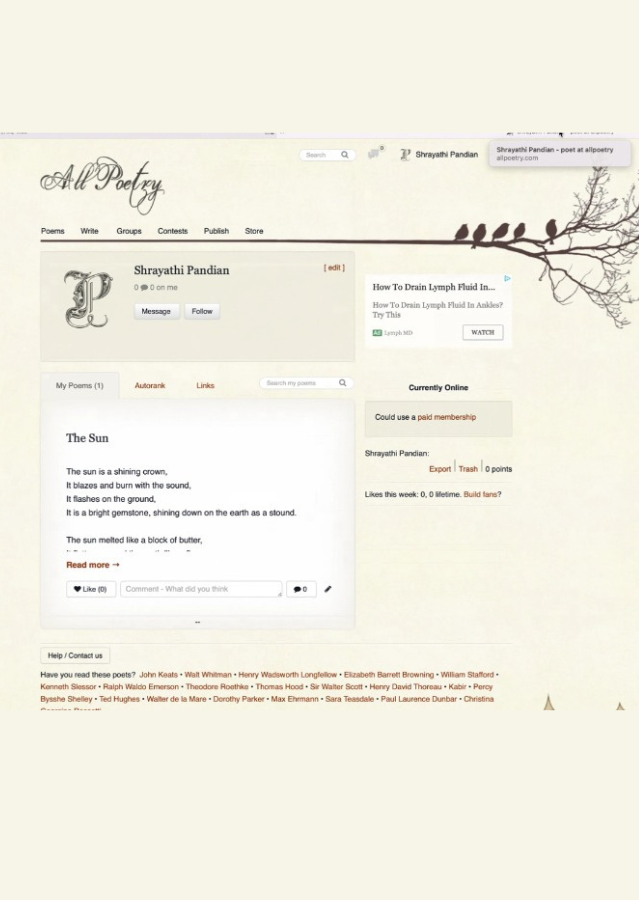
Student Achievements
Making an Impact: 🏆 Student Achievements That Shine | 🌱 Your Growth. Our Mission.




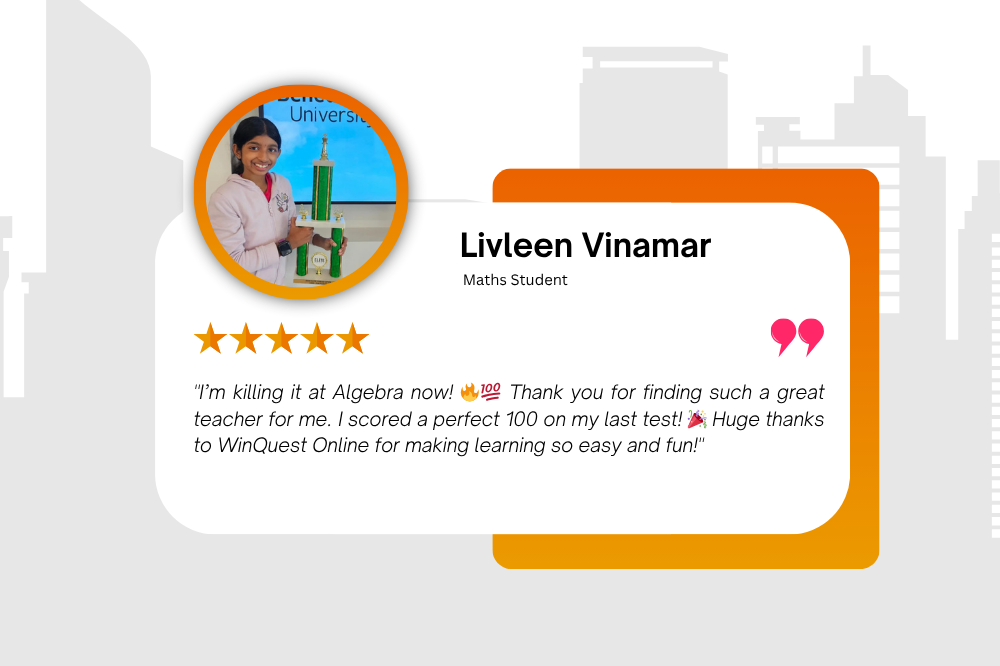
What Our Parents Say About Us
👪 Real Results. Real Parent Voices. 🏆 Futures Built with Care


Parent Testimonials
Success Stories That Speak 🌟🎓 Wins That Inspire Pride 🏆
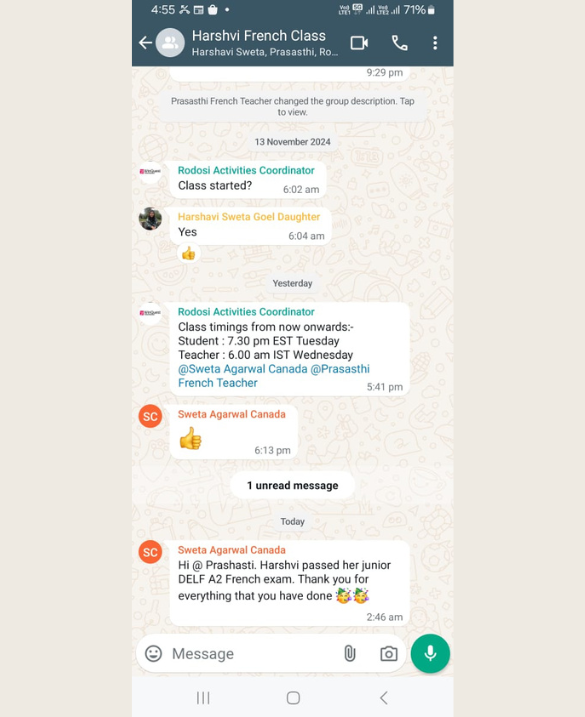
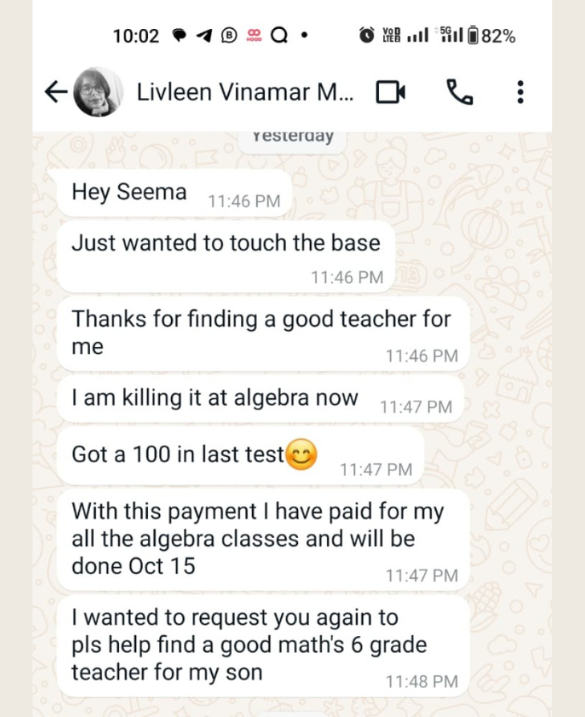
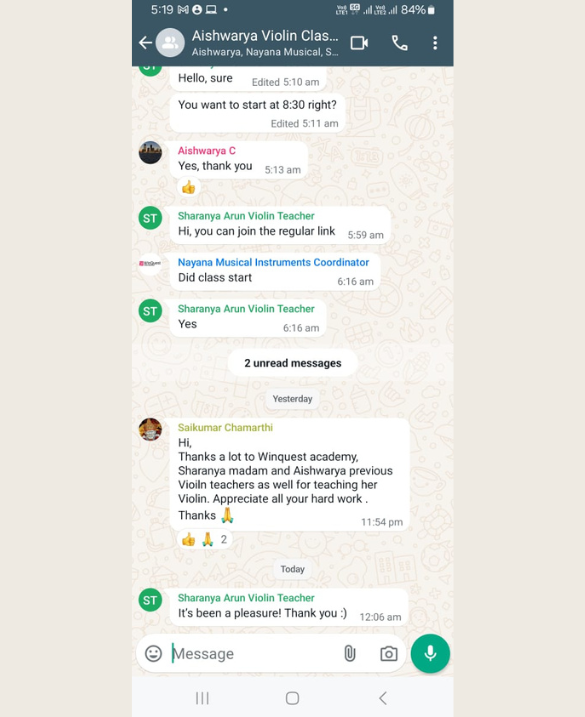
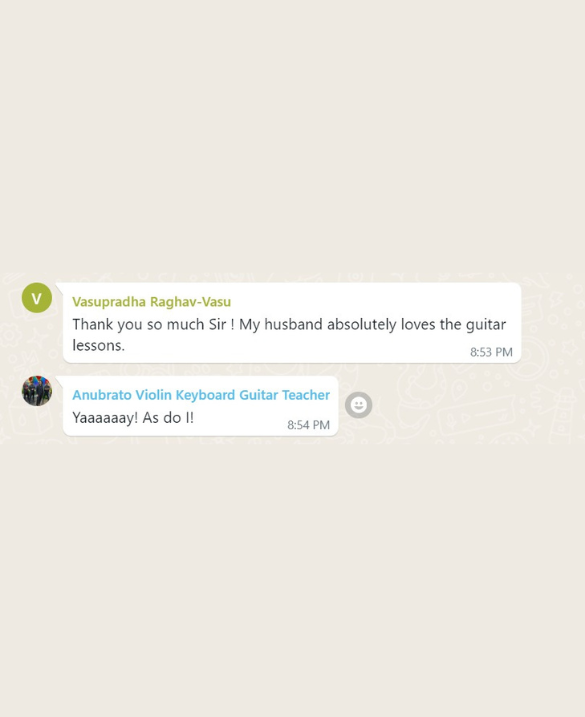
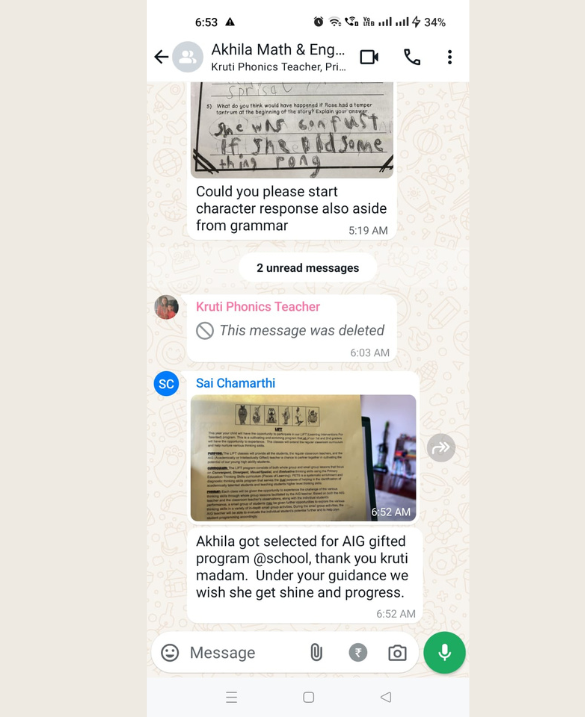
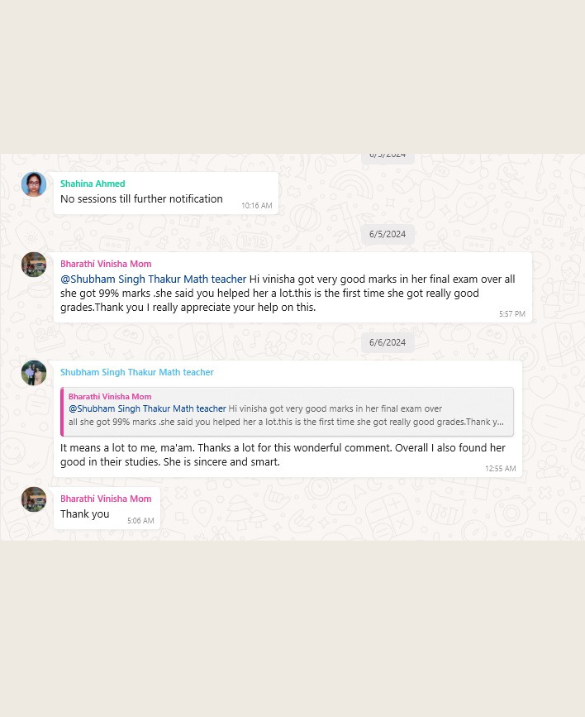
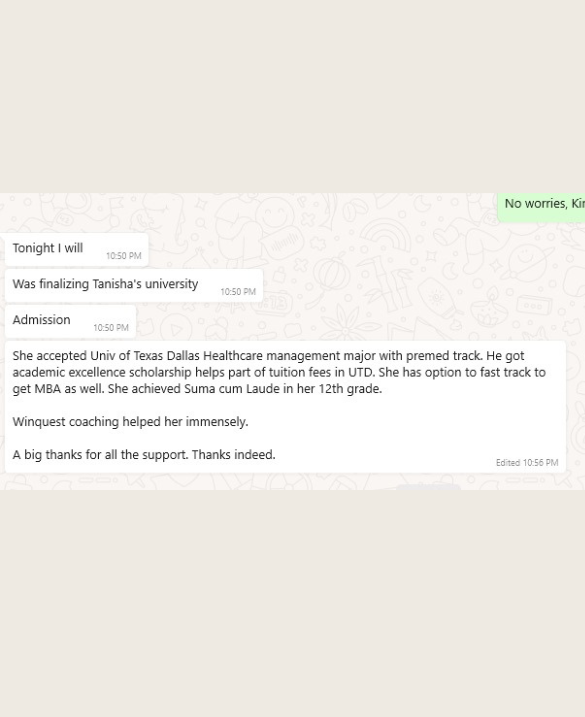
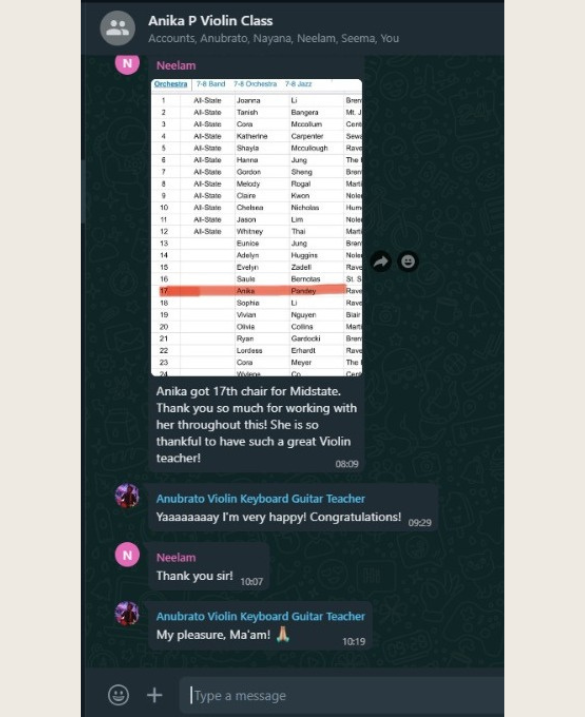
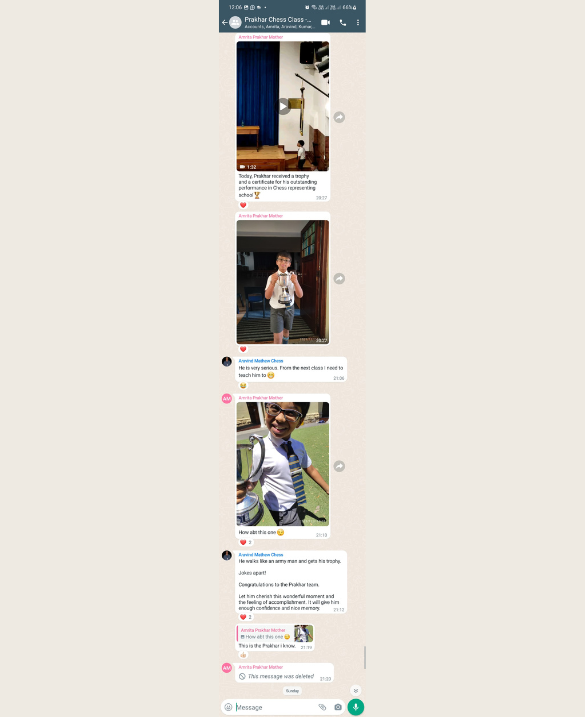
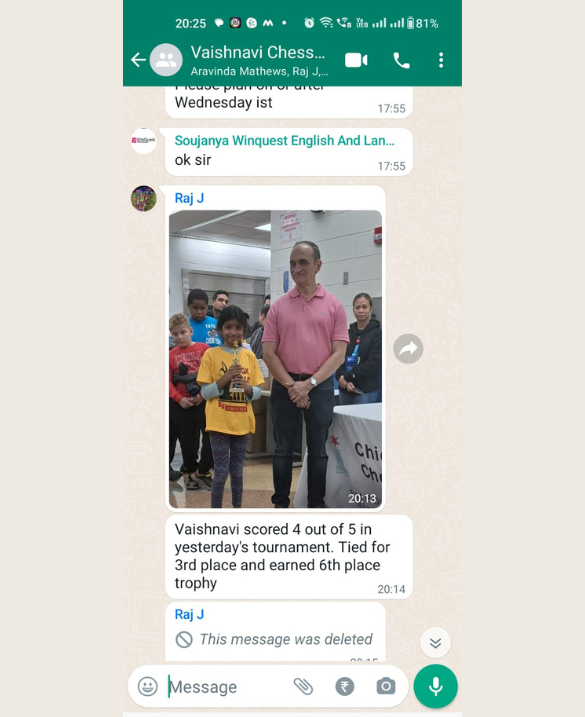
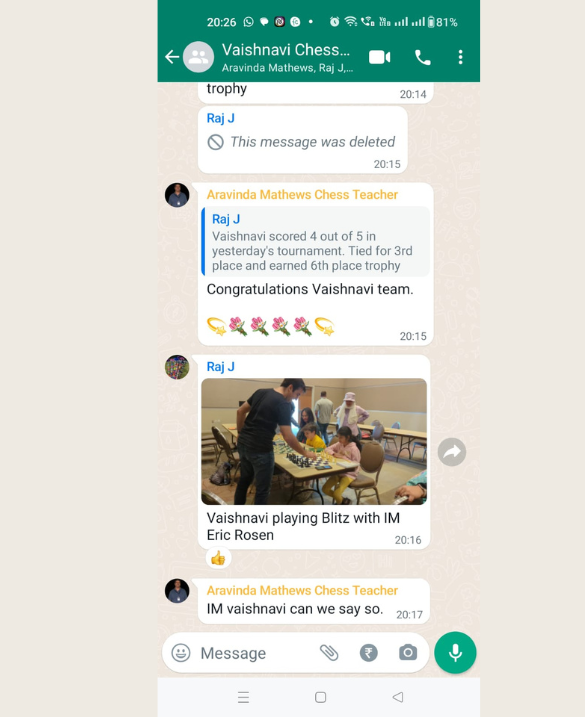
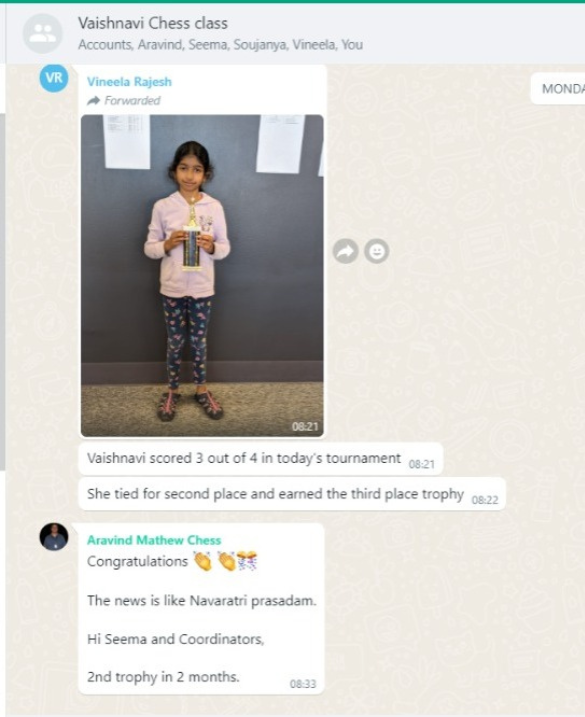
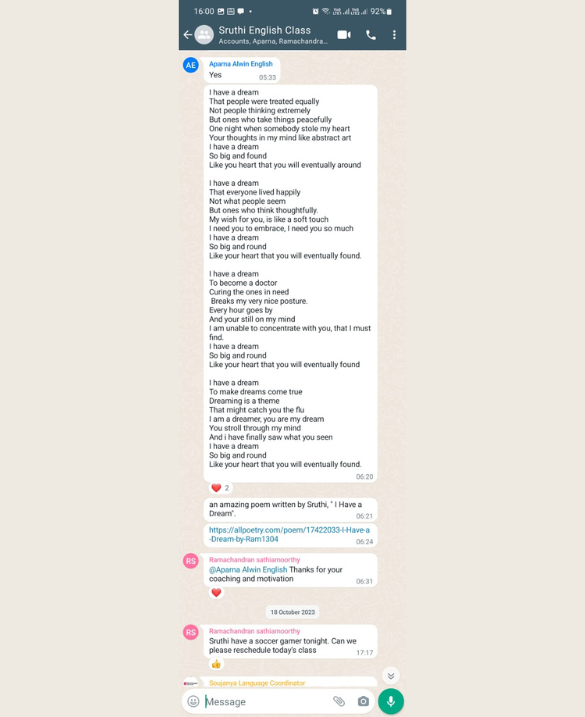
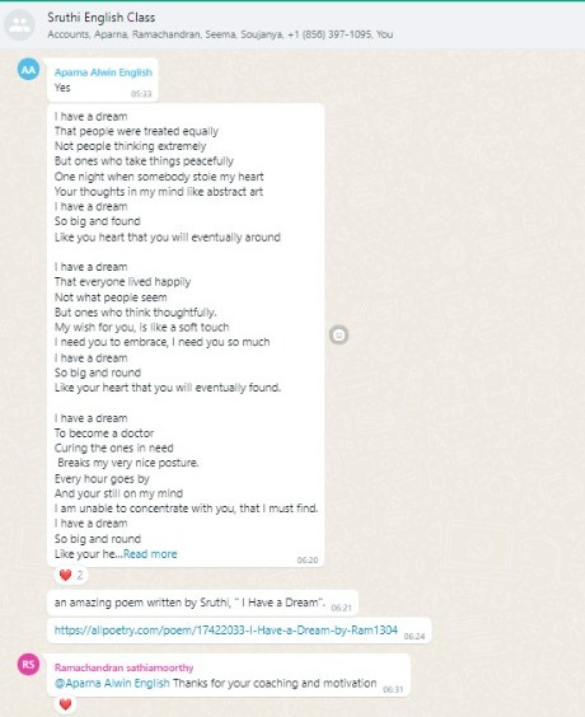
WhatsApp Testimonials
Real Voices from Our WhatsApp Community 💚📚

Latest News and Resources
📰 Learning Updates | 📘 Tips | 🎓 Resources | 💻 Online Courses