


Course Details
Mathematics Grade 9-10
Mathematics Grade 9-10
Why Choose Online Mathematics Grade 9-10 Classes?
Overview
Mathematics Grade 9-10 is high-school math - the foundation for SAT, AP Calculus, ATAR, A-levels, Board exams and university STEM. WinQuest delivers it aligned to your child's board: US Common Core Algebra I / Geometry / Algebra II, Ontario MFM1P/MPM1D/MPM2D, Australian v9.0 Year 9/10, CBSE Class 9/10, ICSE Class 9/10, Cambridge IGCSE Maths (0580), and Singapore O-level Math. Includes board-paper practice and chapter / unit tests.
What You'll Learn
- Live interactive sessions
- 1st one-on-one session
- Comprehensive curriculum
- No long-term commitment
- Personalized learning plan
Grade 9
Algebra - Expressions & Equations+
- Linear equations and inequalities in one variable - solving multi-step including those with variables on both sides; graphing solutions on a number line.
- Systems of linear equations - solving by substitution, elimination, and graphing; identifying systems with one, no, or infinitely many solutions.
- Quadratic expressions - factoring (using common factor, grouping, difference of squares, trinomials), completing the square; introduction to the quadratic formula.
Functions+
- Linear functions f(x) = mx + b and arithmetic sequences (common difference d); writing function notation, evaluating, and graphing.
- Exponential functions f(x) = a x b^x and geometric sequences (common ratio r); modelling growth and decay.
- Quadratic functions f(x) = ax^2 + bx + c and their graphs (parabolas); identifying vertex, axis of symmetry, x- and y-intercepts.
Statistics & Probability+
- Univariate data - representing shape (skewed, symmetric, normal), centre (mean, median), spread (standard deviation, IQR).
- Bivariate data - scatter plots, correlation (positive, negative, none), regression (line of best fit).
- Conditional probability and two-way tables; computing P(A|B) and identifying independence.
Geometry Foundations+
- Congruence using rigid motions (translations, reflections, rotations) and SSS, SAS, ASA congruence criteria.
- Similarity using dilations (scale factor k); AA (angle-angle) similarity criterion for triangles.
- Right-triangle trigonometry - sine (opposite/hypotenuse), cosine (adjacent/hypotenuse), tangent (opposite/adjacent); SOH-CAH-TOA.
Number Sense & Algebra+
- Operations with rational numbers (including negatives) and exponents (including negative and rational exponents).
- Polynomial expressions and operations - adding, subtracting, multiplying, factoring polynomials.
- Solving first-degree equations including those with rational coefficients; rearranging formulas for a specified variable.
Linear Relations+
- Properties of linear relations - slope (rise/run, rate of change), y-intercept (initial value), forms (y = mx + b, Ax + By = C).
- Direct variation (y = kx, passes through origin) and partial variation (y = mx + b, b not 0); identifying from tables, graphs, equations.
- Linear modelling and applications - representing real-world relationships with linear equations.
Analytic Geometry+
- Connecting equations and graphs of lines; finding equations from graphs and graphs from equations.
- Slope of parallel lines (equal) and perpendicular lines (negative reciprocals); writing equations of parallel / perpendicular lines.
- Solving problems using analytic geometry - distance formula, midpoint formula, equation of a circle (x - h)^2 + (y - k)^2 = r^2.
Measurement & Geometry+
- Optimisation - finding maximum area for a given perimeter, or minimum perimeter for a given area.
- Surface area and volume of prisms, pyramids, cylinders, cones, spheres using formulas.
- Properties of polygons (interior / exterior angles, regular vs irregular) and circles (chord, tangent, sector, arc).
Number & Algebra+
- Apply index laws to numerical and algebraic expressions including negative and zero indices.
- Expand binomial products (e.g., (x+2)(x+5) = x^2 + 7x + 10); factorise quadratic expressions using grouping, common factor, identities.
- Solve linear equations including those with brackets and fractions; word problems leading to linear equations.
Linear Functions+
- Sketch linear graphs using gradient and y-intercept; or using x- and y-intercepts; or table of values.
- Find midpoint and length of intervals on a Cartesian plane using midpoint formula and distance formula (from Pythagoras).
- Solve linear simultaneous equations using substitution, elimination, and graphical methods.
Measurement & Geometry+
- Calculate areas of composite shapes by adding / subtracting component shapes; surface area of cylinders (2 pi r h + 2 pi r^2).
- Apply Pythagoras's theorem (a^2 + b^2 = c^2) and trigonometry (SOH-CAH-TOA) to right-angled triangles.
- Use similar triangles to find unknown lengths; identifying similarity using AA, SAS, or SSS criteria.
Statistics & Probability+
- Compare data displays (back-to-back stem-and-leaf, side-by-side box plots, double bar graphs) using mean, median, range.
- Calculate relative frequencies (experimental probability) and identify complementary events (P(A) + P(not A) = 1).
- Two-step chance experiments using tree diagrams; calculating probabilities of compound events.
Number Systems & Polynomials+
- Real numbers - rational (terminating and recurring decimals) and irrational; representation on number line.
- Laws of exponents for real numbers including negative and rational exponents.
- Polynomials - zeroes, factor theorem, remainder theorem, algebraic identities (a+b)^3, (a-b)^3, a^3 + b^3, a^3 - b^3.
Coordinate Geometry & Linear Equations+
- Cartesian system - axes, coordinates of a point, plotting points in all 4 quadrants.
- Linear equations in two variables - solutions, graphs; geometric representation as straight lines.
- Equations of lines parallel to axes (x = a is vertical, y = b is horizontal).
Geometry+
- Euclid's axioms and postulates - the foundation of geometry as a deductive system.
- Lines and angles - vertically opposite angles, angles formed by a transversal cutting parallel lines.
- Triangles - congruence rules (SSS, SAS, ASA, AAS, RHS); inequalities involving sides and angles.
- Quadrilaterals - properties of parallelograms, rhombus, rectangles, squares; circles - chord properties.
Mensuration+
- Surface area and volume of cuboid, cube, cylinder, cone (V = 1/3 pi r^2 h), sphere (V = 4/3 pi r^3), hemisphere.
- Heron's formula for area of triangle - area = sqrt(s(s-a)(s-b)(s-c)) where s = (a+b+c)/2.
- Application problems on surface area and volume in real-life contexts.
Statistics & Probability+
- Frequency distribution; bar graphs, histograms, frequency polygons.
- Mean, median, mode of ungrouped data; choosing appropriate measure.
- Probability - empirical (experimental) probability based on observed frequencies.
Pure Arithmetic & Algebra+
- Rational and irrational numbers; surds and their operations.
- Compound interest using A = P(1 + R/100)^n; profit, loss, discount applications.
- Expansions ((a+b)^3, (a-b)^3) and factorisation of algebraic expressions using identities.
Equations & Indices+
- Linear equations in one variable and simultaneous linear equations in two variables.
- Indices and laws of indices; logarithms - introduction, laws, common logarithm.
- Quadratic expressions - factorisation using identities, common factors, grouping.
Geometry+
- Triangles - congruence and inequalities (e.g., sum of any two sides > third side).
- Mid-point theorem and its converse; isosceles triangle properties.
- Rectilinear figures - properties of quadrilaterals and parallelograms; theorems on parallelograms.
Mensuration+
- Area of plane figures including triangles, parallelograms, rhombus, trapezium.
- Solids - cube, cuboid, cylinder; surface area and volume formulas.
- Heron's formula and its application to triangles given three sides.
Trigonometry & Statistics+
- Trigonometric ratios of acute angles - sin, cos, tan, cot, sec, cosec.
- Standard angles - 0, 30, 45, 60, 90 degrees - exact values of trig ratios.
- Statistics - frequency distribution, mean, median, mode of ungrouped data.
Number+
- Types of numbers (natural, integers, rational, irrational, real); HCF, LCM by prime factorisation.
- Decimals, fractions, percentages and their interconversion; standard form (a x 10^n).
- Indices including fractional and negative; surds and rationalising denominators (Extended); upper and lower bounds.
Algebra+
- Linear equations, inequalities, simultaneous equations - solving by elimination, substitution, graphical.
- Factorisation by common factor, grouping, difference of squares, trinomials; expansion of brackets including binomials and trinomials; completing the square.
- Quadratic equations - solving by formula, factoring, completing the square, graphical method.
Coordinate Geometry & Graphs+
- Straight-line graphs - gradient (m), midpoint, length using distance formula; equations of lines.
- Plotting quadratic (parabola), cubic, reciprocal, exponential graphs; identifying key features.
- Function notation f(x); composite functions fg(x); inverse functions f^-1(x) - Extended only.
Geometry & Mensuration+
- Polygons - interior angles ((n-2) x 180), exterior angles (sum 360), properties; circle theorems (Extended).
- Pythagoras and trigonometry - SOH-CAH-TOA, sine rule (Extended), cosine rule (Extended).
- Mensuration - prism, cylinder, cone, sphere, hemisphere; composite solids; arc length and sector area.
Statistics & Probability+
- Frequency distribution; mean, median, mode, range; cumulative frequency curves and quartiles.
- Histograms with unequal class widths using frequency density (Extended).
- Probability of single and combined events; using Venn diagrams and tree diagrams.
Number+
- Standard form (scientific notation) and the laws of indices (including negative and fractional).
- Roots and surds (introduction) - simplifying surds; rationalising denominators.
- Compound percentages (e.g., compound interest) and reverse percentages (finding original from final).
Algebra+
- Expand brackets including double brackets; factorise quadratic expressions using common factor and trinomials.
- Construct and solve linear equations and inequalities including those with brackets and variables on both sides.
- Sequences - linear (arithmetic) and quadratic; finding n-th term formula.
Geometry & Measure+
- Pythagoras's theorem (a^2 + b^2 = c^2) applied to 2-D real-world problems.
- Bearings (three-figure bearings 000 to 360 measured clockwise from north) and scale drawings.
- Volume and surface area of prisms (V = base area x height) and cylinders (V = pi r^2 h).
Statistics & Probability+
- Construct and interpret stem-and-leaf plots (including back-to-back) and box plots (5-number summary).
- Calculate mean, median, mode and range of grouped data using mid-class values.
- Tree diagrams for two-step events; calculating probabilities of compound events.
Numbers & Algebra+
- Indices including fractional and negative; standard form (scientific notation).
- Algebraic manipulation - expansion of brackets, simplification; factorisation by various methods (common factor, grouping, trinomials, difference of squares).
- Quadratic equations - solving by factorisation, formula (x = (-b +- sqrt(b^2 - 4ac))/2a), completing the square.
Functions & Graphs+
- Linear, quadratic, exponential function graphs; identifying key features (intercepts, vertex, asymptotes).
- Coordinate geometry - distance formula, gradient, midpoint formula; equation of a line.
- Linear inequalities - representing solution regions graphically (shading the region).
Geometry & Mensuration+
- Congruence (SSS, SAS, ASA, RHS) and similarity (AA, SAS, SSS) of triangles.
- Pythagoras's theorem and its converse; trigonometric ratios (SOH-CAH-TOA) for right-angled triangles.
- Volume and surface area of pyramids (V = 1/3 base area x h), cones (V = 1/3 pi r^2 h), spheres (V = 4/3 pi r^3).
Statistics & Probability+
- Histograms (with equal class widths) and frequency polygons.
- Mean, median, mode of grouped (using mid-values) and ungrouped data.
- Probability - simple events using P(E) = favourable / total outcomes.
Grade 10
Algebra II - Polynomial & Rational Functions+
- Polynomial arithmetic (addition, subtraction, multiplication, long division); factor theorem and remainder theorem.
- Rational expressions and equations - simplification, addition / subtraction, multiplication / division; solving.
- Complex numbers (a + bi where i^2 = -1) and complex roots of quadratic equations.
Exponential & Logarithmic Functions+
- Exponential growth and decay (y = a x b^x); compound interest, population, radioactive decay.
- Logarithm properties (log(ab) = log a + log b, log(a/b) = log a - log b); solving exponential and logarithmic equations.
- Modelling with exponential and logarithmic functions in real-world contexts.
Trigonometric Functions+
- Unit circle (radius 1) and radian measure (2 pi radians = 360 degrees); converting between degrees and radians.
- Trigonometric functions (sin, cos, tan) of any angle including obtuse and reflex; sign of each in the four quadrants.
- Inverse trigonometry (arcsin, arccos, arctan); trigonometric identities (sin^2 + cos^2 = 1, etc.).
Geometry - Circles & Beyond+
- Circles - inscribed angles, central angles, tangents, secants; circle theorems and proofs.
- Conic sections (parabola, ellipse, hyperbola) - introduction to their equations and graphs.
- Volume formulas - prisms (V = base x height), cylinders, cones, spheres, pyramids; application problems.
Statistics - Inferential+
- Sampling and the role of randomisation in obtaining representative samples.
- Population parameters (mean mu, standard deviation sigma) and sample statistics (mean x-bar, standard deviation s).
- Confidence intervals for population mean; hypothesis tests - introduction with t-test.
Quadratic Relations+
- Properties of quadratic functions (vertex, axis of symmetry, intercepts, max / min).
- Solving quadratic equations - factoring, quadratic formula (x = (-b +- sqrt(b^2 - 4ac))/2a), completing the square.
- Modelling with quadratic functions - projectile motion, area optimisation, revenue.
Analytic Geometry+
- Linear systems (2x2 and 3x3) - solving by substitution, elimination, matrix method; applications.
- Distance formula d = sqrt((x2-x1)^2 + (y2-y1)^2), midpoint formula ((x1+x2)/2, (y1+y2)/2) and slope (rise/run).
- Properties of geometric figures using analytic (coordinate) methods - proofs using slopes, distances, midpoints.
Trigonometry+
- Right-triangle trigonometry (SOH-CAH-TOA); sine rule (a/sin A = b/sin B = c/sin C) and cosine rule (c^2 = a^2 + b^2 - 2ab cos C).
- Solving 2-D and 3-D problems using trigonometry - angles of elevation / depression, bearings.
- Similar and congruent triangles in real-world contexts (heights of buildings, distances across rivers).
Functions (intro)+
- Function notation f(x); finding the inverse function f^-1(x); domain and range.
- Transformations of functions - translations (f(x) + a, f(x + a)), reflections, stretches; combining transformations.
- Modelling with functions (linear, quadratic, exponential) to fit real-world data.
Number & Algebra+
- Apply the index laws to algebraic expressions; surds (10A) - simplifying and rationalising denominators.
- Factorise and simplify algebraic expressions including those involving fractions.
- Solve quadratic equations algebraically (factoring, formula, completing the square) and graphically.
Linear & Non-linear Relationships+
- Sketch graphs of quadratic (parabola), exponential, hyperbolic (y = k/x), absolute value functions.
- Solve linear simultaneous equations - algebraically (substitution, elimination) and graphically.
- Solve linear inequalities including double inequalities and those involving absolute value.
Measurement & Geometry+
- Surface area and volume of pyramids (V = 1/3 base x h), spheres (V = 4/3 pi r^3), composite solids.
- Trigonometric ratios; solving non-right triangles using the sine and cosine rules (10A).
- Geometric proofs using congruence (SSS, SAS, ASA, RHS) and similarity (AA, SAS, SSS).
Statistics & Probability+
- Bivariate data analysis - scatter plots, correlation coefficient, line of best fit, residual analysis.
- Conditional probability P(A|B) = P(A and B) / P(B) and independence (P(A and B) = P(A) x P(B)).
- Standard deviation as a measure of spread (10A); calculating and interpreting.
Real Numbers, Polynomials, Linear Eqs.+
- Euclid's division lemma (a = bq + r); HCF and LCM by prime factorisation; revisiting irrational numbers.
- Polynomials - relationship between zeroes and coefficients; division algorithm for polynomials.
- Pair of linear equations in two variables - solving by graphical, substitution, elimination, cross-multiplication methods.
Quadratic Equations & APs+
- Quadratic equations - solving by factorisation, completing the square, formula; nature of roots from discriminant.
- Arithmetic progressions (AP) - n-th term a_n = a + (n-1)d; sum of n terms S_n = n/2 (2a + (n-1)d).
- Word problems involving quadratic equations and APs in real-life contexts.
Coordinate Geometry & Triangles+
- Distance formula, section formula (internal and external division), area of triangle from coordinates.
- Triangles - similarity criteria (AA, SAS, SSS); Pythagoras theorem converse and applications.
- Areas of similar triangles - ratio of areas = ratio of squares of corresponding sides.
Circles, Trigonometry, Constructions+
- Tangents to circles - length of tangent from external point; tangent perpendicular to radius at point of contact.
- Trigonometric ratios; identities (sin^2 + cos^2 = 1; sec^2 - tan^2 = 1; cosec^2 - cot^2 = 1); complementary angles.
- Heights and distances - angle of elevation and depression; real-life problems involving towers, hills.
Mensuration & Statistics+
- Areas of plane figures including circle segments and sectors using A = (theta/360) x pi r^2.
- Surface area and volume of combined solids (e.g., hemisphere on cylinder, cone on cylinder).
- Statistics - mean, median, mode of grouped data using direct, assumed-mean, step-deviation methods; probability of single event.
Commercial Math & Algebra+
- GST and banking - sales tax, VAT, GST calculations; recurring deposit, savings account.
- Shares and dividends; banking - matured value of fixed deposits.
- Linear inequations in one variable; quadratic equations in one variable - factorisation, formula method, nature of roots.
Ratio, Proportion, Factor Theorem+
- Ratio and proportion - direct and inverse; properties (compound, alternate, invertendo, componendo, dividendo).
- Factor theorem and remainder theorem - using them to find factors of polynomials.
- Matrices - introduction; addition, subtraction, scalar multiplication, matrix multiplication; identity matrix.
Coordinate Geometry & Geometry+
- Reflection in x-axis, y-axis, origin; section formula; slope and equation of a line (point-slope, two-point, slope-intercept forms).
- Similarity of triangles; properties of chords and tangents to circles.
- Cyclic quadrilaterals (opposite angles sum to 180); constructions using ruler and compass.
Mensuration & Trigonometry+
- Cylinder, cone, sphere - surface area and volume; combined solids (frustum, cone on hemisphere).
- Heights and distances using trigonometry - angle of elevation / depression; real-life applications.
- Trigonometric identities and tables; proving identities using fundamental identities.
Statistics & Probability+
- Histograms, ogives (cumulative frequency curves), frequency polygons.
- Mean (by assumed mean, step deviation), median, mode of grouped data; quartiles and inter-quartile range.
- Probability of simple and combined events using P(A or B) = P(A) + P(B) - P(A and B).
Number & Algebra (Extended)+
- Surds and rationalising denominators (e.g., simplify 1/sqrt(2) = sqrt(2)/2).
- Algebraic fractions - simplification, addition, subtraction, multiplication, division; complex algebraic manipulation.
- Quadratic equations - solving by formula, completing the square, graphical method; discriminant.
Functions & Graphs (Extended)+
- Function notation f(x); composite functions fg(x); inverse functions f^-1(x).
- Sketching cubic, exponential, logarithmic, reciprocal graphs; identifying key features (asymptotes, intercepts).
- Gradient of curves; differentiation of polynomial functions; finding turning points (Extended only).
Coordinate Geometry & Trigonometry+
- Equations of straight lines (y = mx + c, point-slope, two-point); parallel (equal gradient) and perpendicular (negative reciprocal).
- Sine rule (a/sin A = b/sin B), cosine rule (a^2 = b^2 + c^2 - 2bc cos A), area of triangle = 1/2 ab sin C.
- Bearings (three-figure) and 3-D trigonometry - finding angles between lines and planes.
Geometry, Mensuration & Vectors+
- Similar triangles - linear ratio k means area ratio k^2 and volume ratio k^3.
- Mensuration - prisms, cylinders, cones, spheres, composite solids; arc length, sector area.
- Vectors - addition, subtraction, scalar multiplication, magnitude using |v| = sqrt(x^2 + y^2) (Extended).
Statistics & Probability+
- Cumulative frequency curves and quartiles (Q1, Q2 = median, Q3); inter-quartile range (Q3 - Q1).
- Histograms with unequal class widths using frequency density = frequency / class width.
- Probability with Venn diagrams, tree diagrams, conditional probability P(A|B) (Extended only).
Note+
- For Grade 10, Cambridge-pathway students sit IGCSE 0580 Mathematics
- See the IGCSE 0580 Extended column above for the syllabus
- Coursework / examination preparation runs through Year 10 and 11
Functions & Graphs+
- Quadratic functions - finding max / min using completing the square; sketching parabolas.
- Exponential functions y = a x b^x; graphs of y = e^x and y = ln x (Additional Math).
- Polynomials and partial fractions decomposition (Additional Math).
Trigonometry & Geometry+
- Trigonometric ratios; identities (sin^2 + cos^2 = 1; tan = sin/cos); R sin(x + alpha) form (Add Math).
- Solving triangles - sine rule, cosine rule, area of triangle = 1/2 ab sin C.
- Vectors in two dimensions - addition, scalar multiplication, position vectors, magnitude (Additional Math).
Mensuration & Coordinate Geometry+
- Arc length s = r theta (in radians) and area of sector A = 1/2 r^2 theta.
- Coordinate geometry - equation of circle (x - h)^2 + (y - k)^2 = r^2 (Additional Math).
- Loci - introduction (set of points satisfying a condition).
Calculus (Additional Math)+
- Differentiation from first principles (limit definition); rules - power, sum, chain (Additional Math).
- Application of differentiation - rates of change, max / min (turning points), tangent and normal lines.
- Integration as the reverse of differentiation; finding indefinite and definite integrals.
Statistics & Probability+
- Cumulative frequency curves and quartiles (Q1, Q2, Q3); inter-quartile range.
- Probability - independent events (multiplication rule) and dependent events (conditional probability).
- Set notation (union, intersection, complement, subset); Venn diagrams for 2 and 3 sets.
Requirements
- A laptop or desktop with stable internet
- A scientific calculator (IGCSE allows graphics calc; check your board's rules)
- Geometry box, notebook
- School textbook + past papers for IGCSE / O-level / Board candidates
Reviews
4.8 / 5 ★ · 320+ students enrolled
Parents consistently rate our mentors for personalised attention, clear concepts and steady progress. Book a free demo to experience a class first-hand.
Frequently Asked Questions
How do I get started?+
Click the Book a Demo button on this page and fill in your child's grade and school board (CBSE / ICSE / IGCSE / Cambridge / US Common Core / Singapore MOE etc.). We will schedule a free trial session with a matching tutor. For details, contact our coordinator on WhatsApp at +91 93308 11581 or email contact@winquestonline.com.
Will the tutor follow my child's school board?+
Yes. Every WinQuest tutor is mapped to specific curricula. Before the first class we ask which board your child follows; the tutor uses that board's scope and sequence, supports the school textbook chapter by chapter, and adds worksheets in the board's exam style. We currently support US Common Core, Ontario, Australian v9.0, CBSE (NCERT), ICSE (CISCE), IGCSE 0580 / 0500 / 0610 / 0620 / 0625, Cambridge Primary / Lower Secondary, and Singapore MOE.
How does payment work?+
We require monthly advance payments for the number of classes scheduled in that calendar month. We accept Zelle, PayPal, UPI (for India), Stripe and major credit / debit cards. You can select your preferred payment method during the initial enrolment.
What if my child misses a class?+
For 1:1 sessions we reschedule a make-up at a mutually convenient time at no extra cost (with at least 24 hours notice). For group classes we share a timed recording of the session on parent request, so your child can catch up before the next class.
How long is each class?+
Each class session is 60 minutes long for academic subjects. Frequency is typically twice a week for K-7 grades and 2-3 times a week for high school, based on the board exam timeline and parent preference.
How is progress measured?+
Tutors give written feedback on every homework assignment, run a short formative quiz every 4-6 classes, and a longer chapter test at the end of each topic. Parents receive a monthly progress report covering concept mastery, homework completion and test scores.
What is the class size?+
For 1:1 sessions the class is just your child and the tutor. For group classes we cap each batch at 6-8 students so every learner gets individual attention and can ask questions in real time.
Are the tutors qualified?+
All our tutors are highly qualified subject-matter experts with proven track records - many hold Master's degrees in their subject and several years of school-curriculum teaching experience. Each tutor is interviewed by our academic head before joining and is mapped to specific boards and grades.
What if my child needs to pause for a school break or exam?+
Just let us know in advance. There are no contracts - you can pause for a school holiday or final-exam stretch and resume when the student is ready, with no penalty.
What are the requirements?+
A laptop or desktop with a stable internet connection is required. Pencil, eraser, ruler and a notebook for working out solved problems. For higher grades a basic calculator. The tutor will list any board-specific requirements (textbook, geometry box, etc.) before the first class.
Student Reviews
No reviews yet — be the first to share your experience with this course!
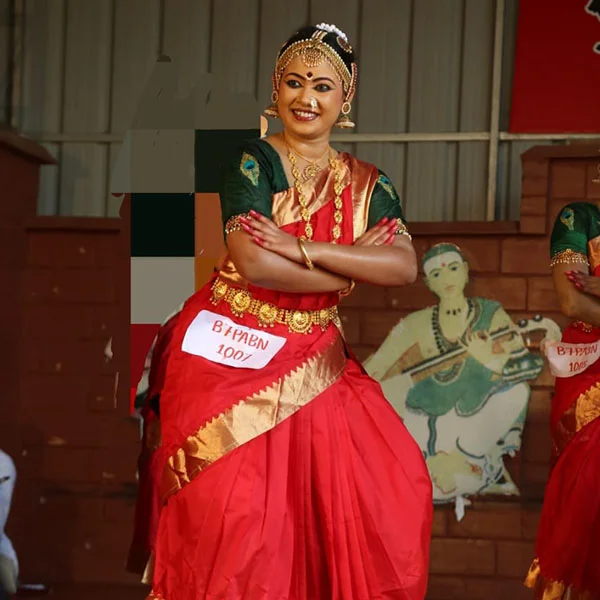
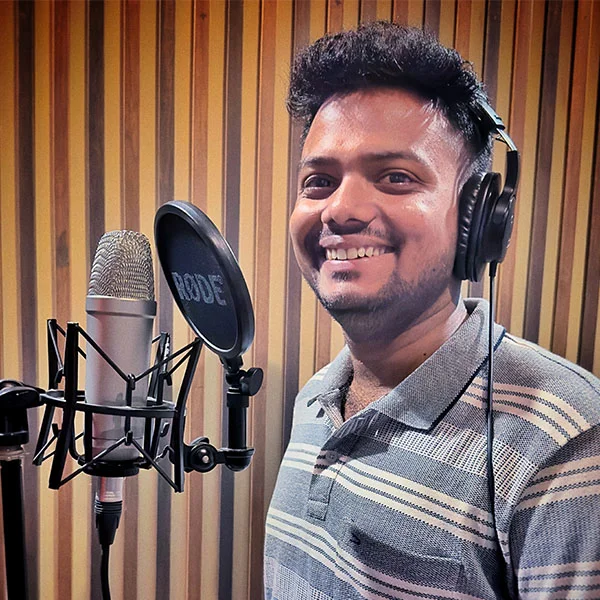
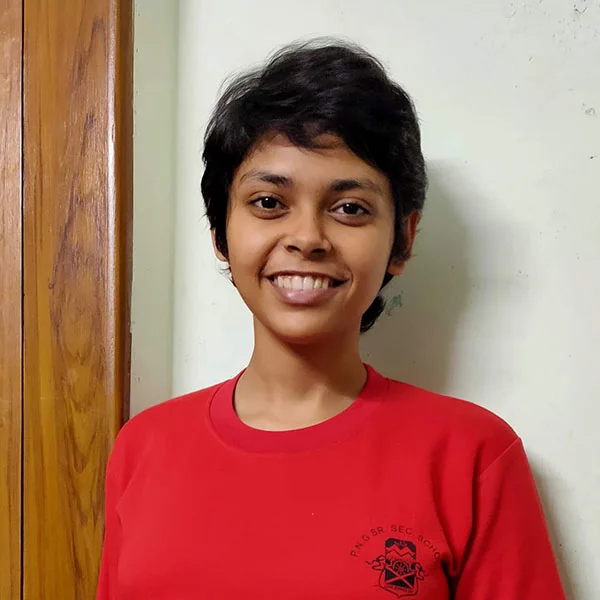
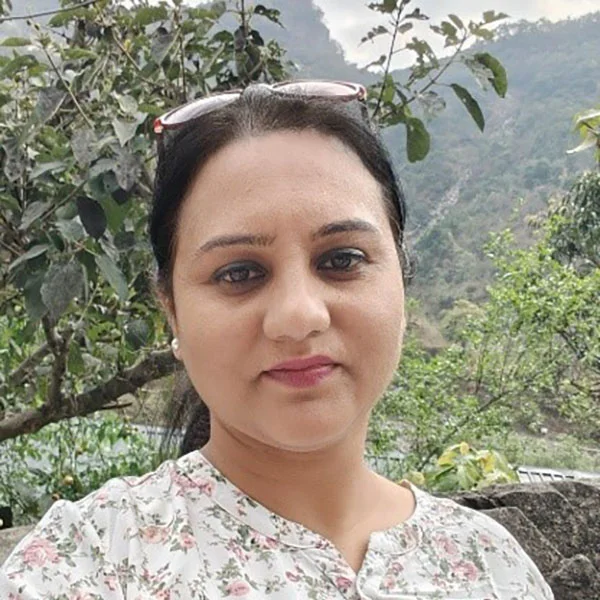
Meet our Teachers
Expert educators who connect, guide, and prepare students with special personalized care ❤️📚✨











Student Achievements
Making an Impact: 🏆 Student Achievements That Shine | 🌱 Your Growth. Our Mission.
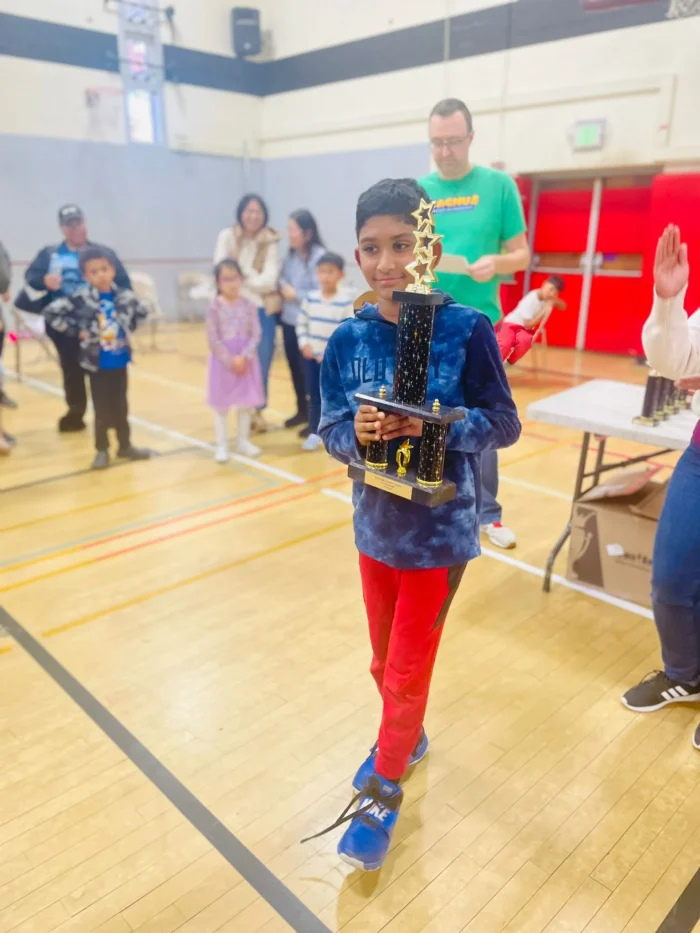



What Our Parents Say About Us
👪 Real Results. Real Parent Voices. 🏆 Futures Built with Care

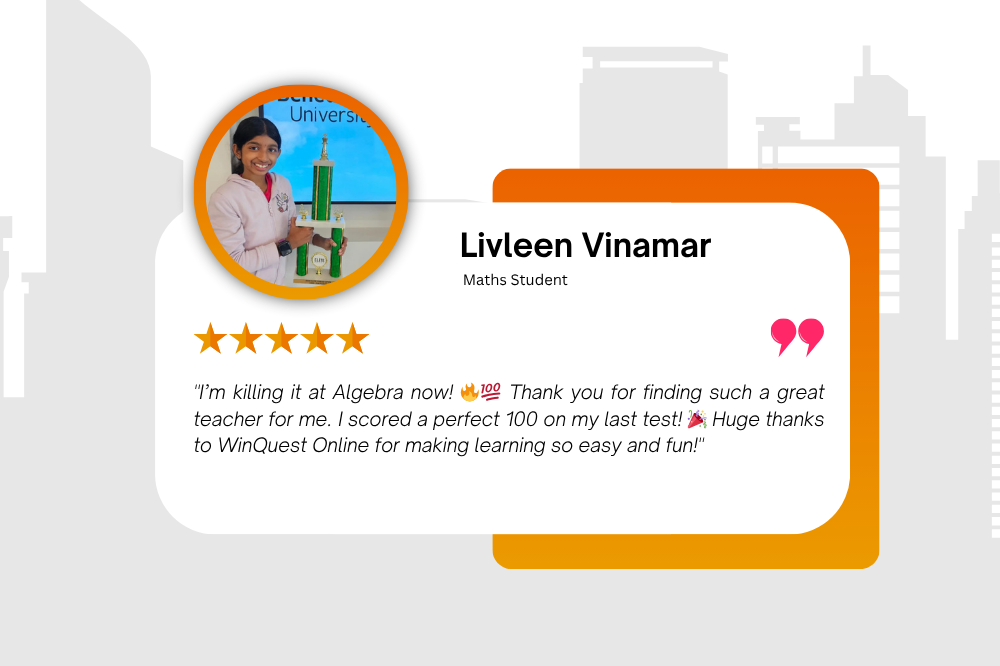
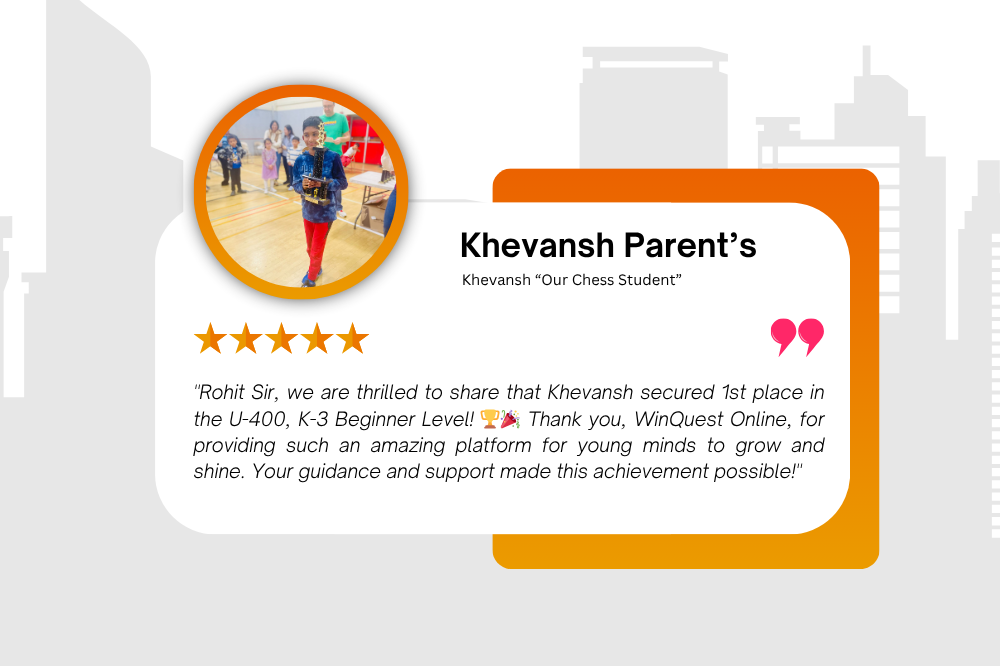
Parent Testimonials
Success Stories That Speak 🌟🎓 Wins That Inspire Pride 🏆
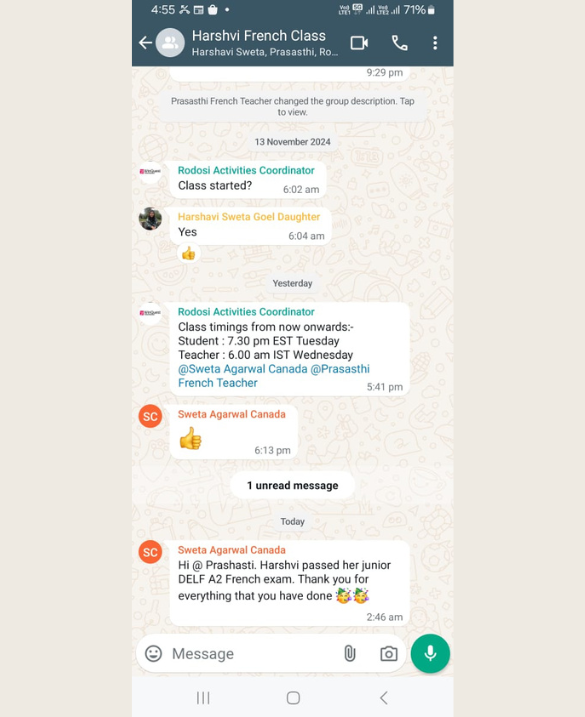
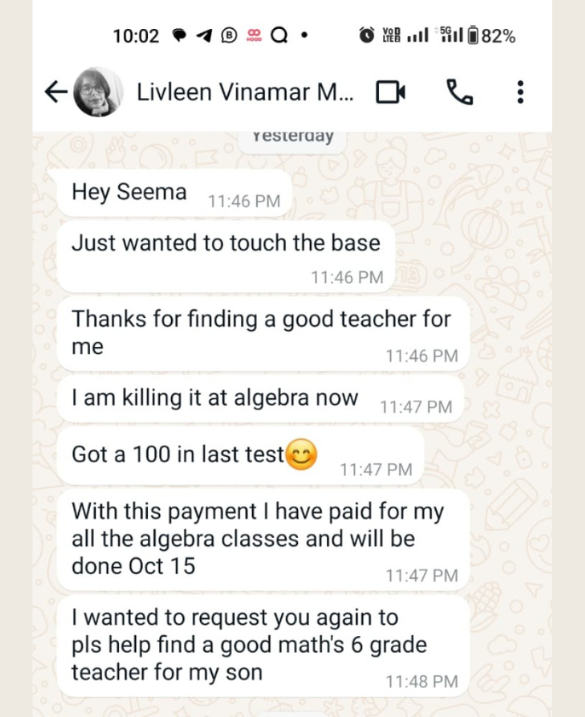
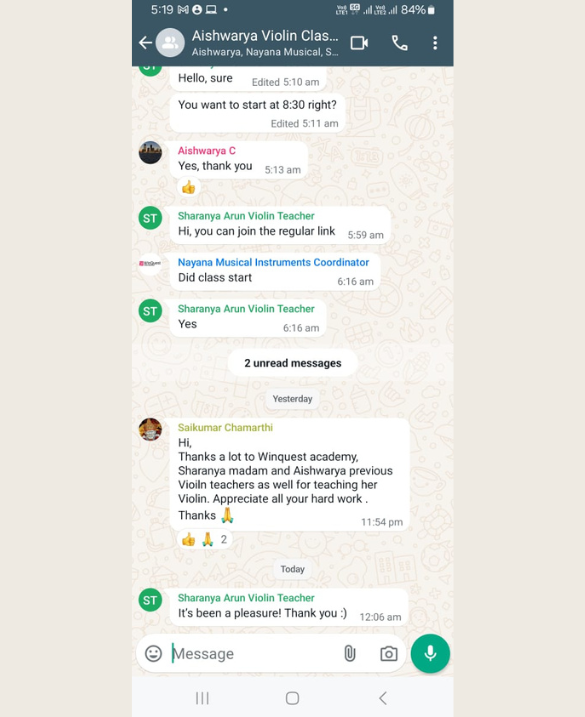
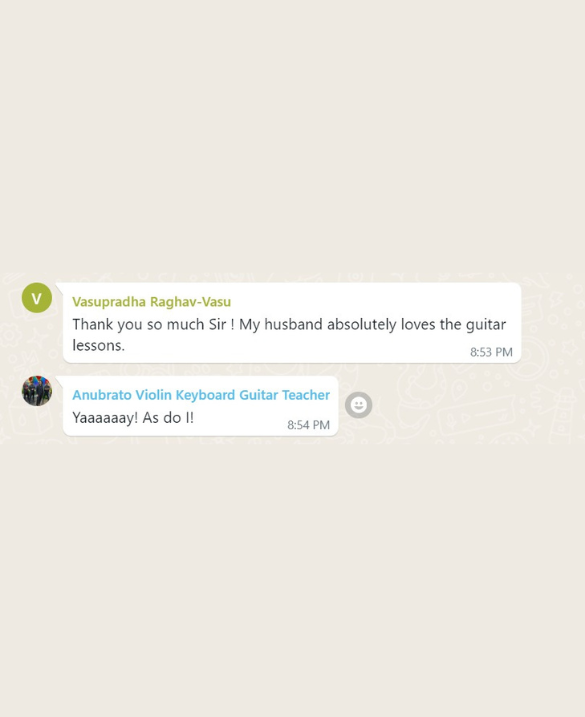
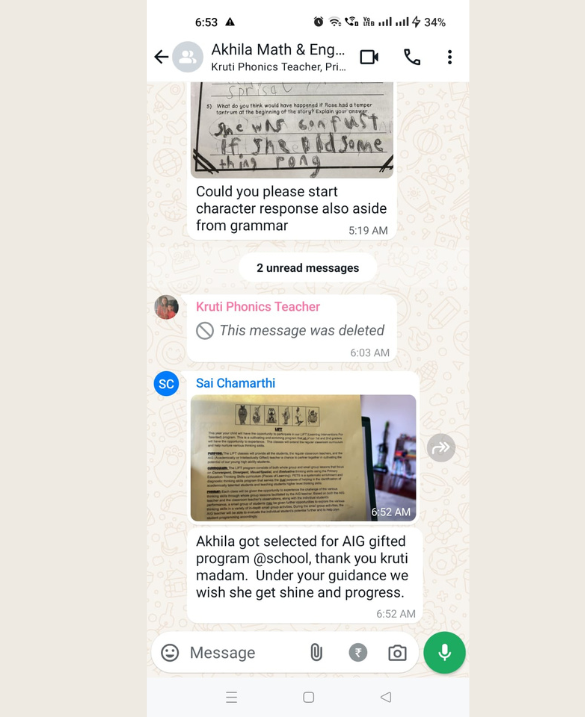
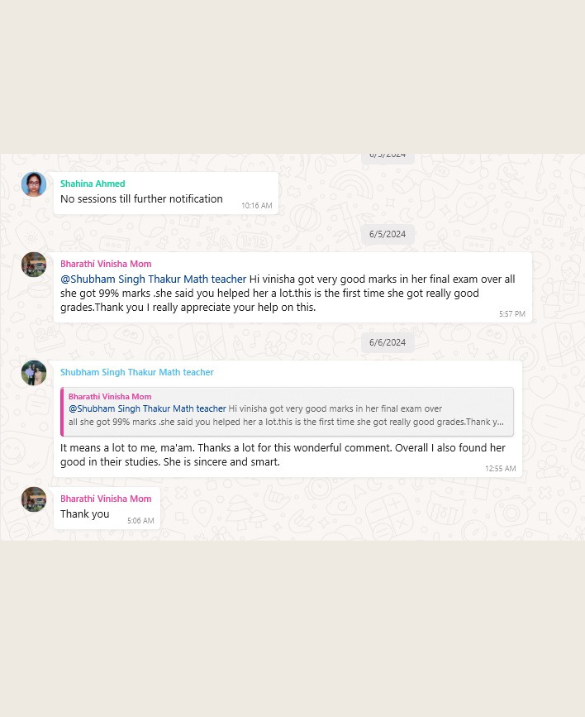
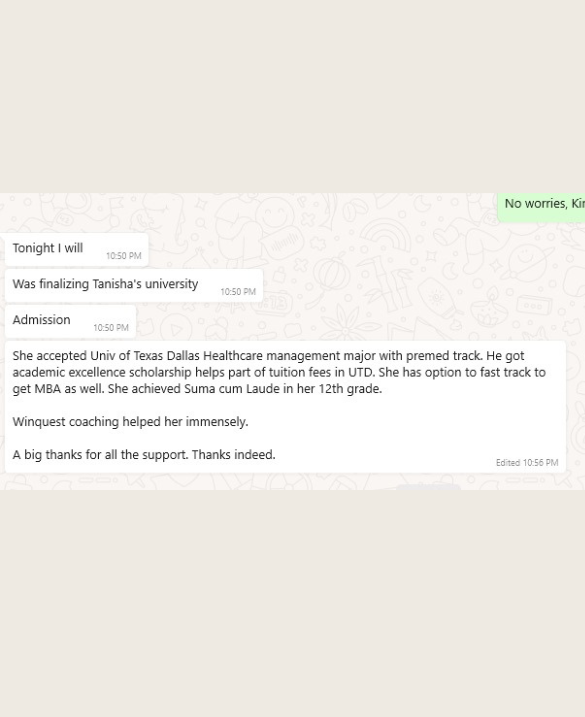
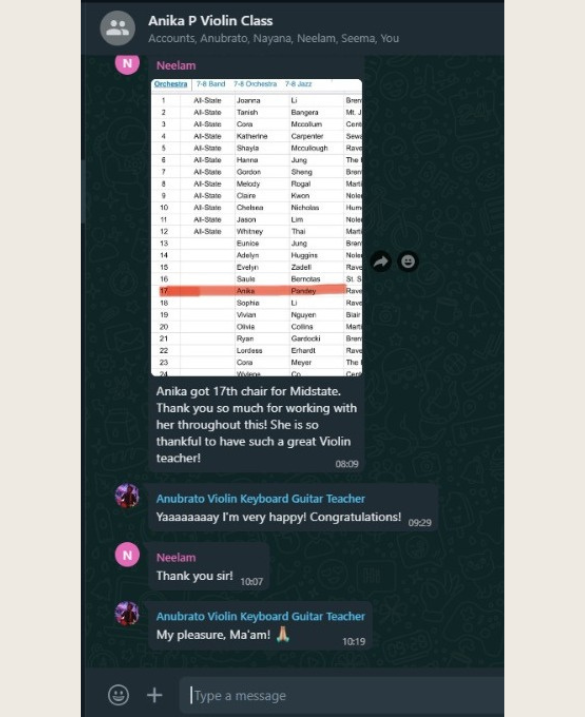
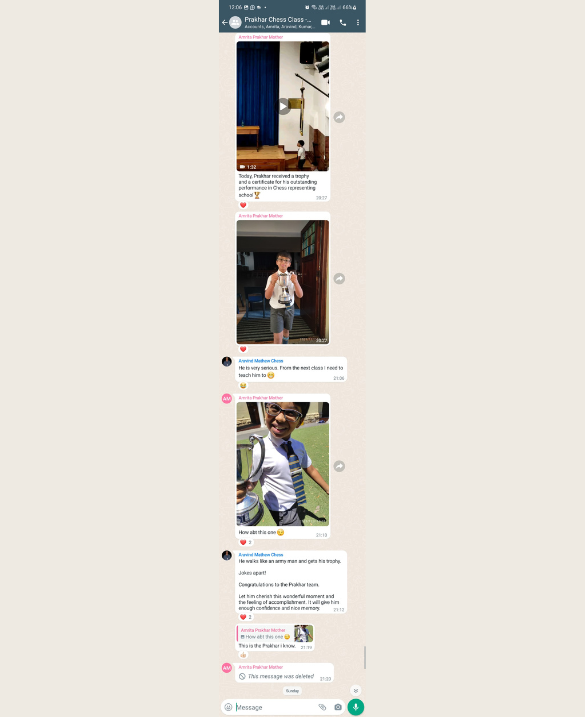
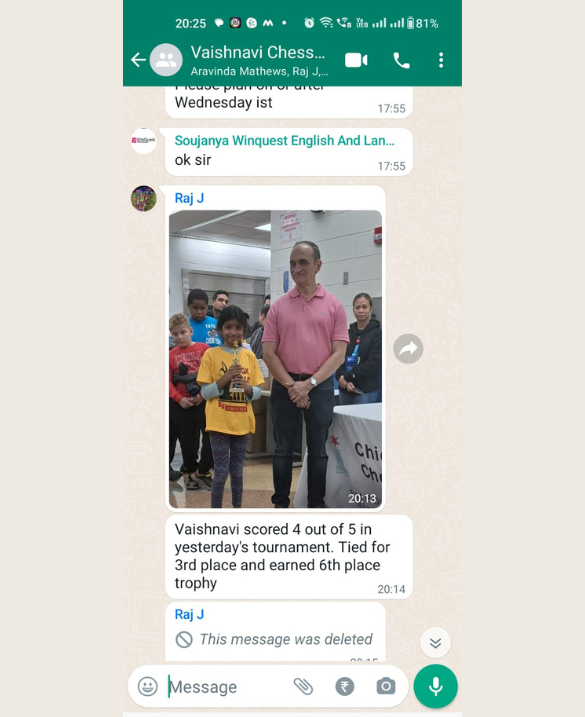
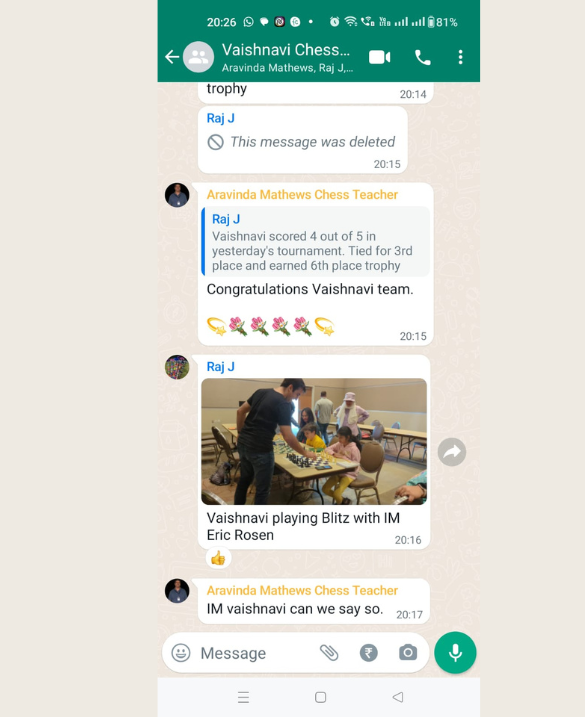
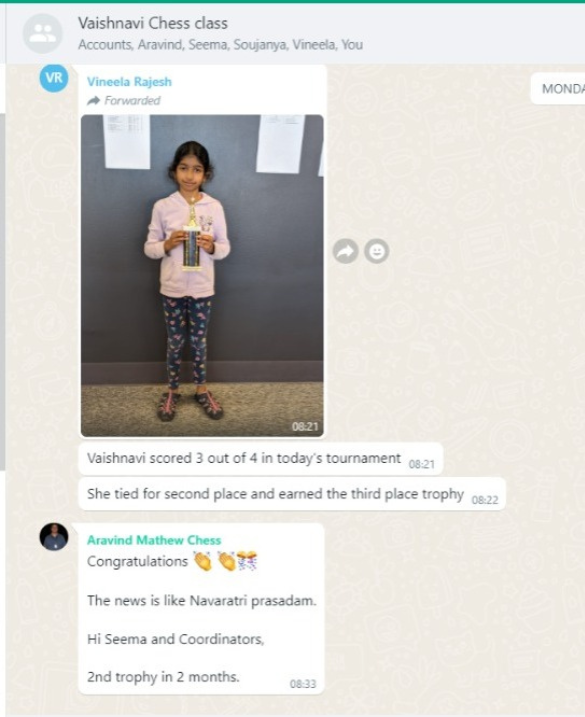
WhatsApp Testimonials
Real Voices from Our WhatsApp Community 💚📚

Latest News and Resources
📰 Learning Updates | 📘 Tips | 🎓 Resources | 💻 Online Courses