


Course Details
Economics
Economics
Why Choose Online Economics Classes?
Overview
Economics is offered as a senior-secondary subject in most boards from Grade 11 onwards (in some boards from Grade 9). WinQuest delivers it aligned to your board: AP Macroeconomics / Microeconomics, IB Economics, Cambridge IGCSE (0455) and AS / A-level (9708), CBSE Class 11/12, ISC Class 11/12, ATAR Economics, or Singapore H2 Economics.
What You'll Learn
- Live interactive sessions
- 1st one-on-one session
- Comprehensive curriculum
- No long-term commitment
- Personalized learning plan
Foundation (Grade 9-10)
Basic Economic Problem+
- Scarcity (unlimited wants vs limited resources), choice (which wants to satisfy), and opportunity cost (next-best alternative forgone).
- Factors of production - land (natural resources), labour (human effort), capital (machines, tools), enterprise (organising the others).
- Economic systems - market (private ownership, price mechanism), planned (state ownership, central planning), mixed (combines both).
Allocation of Resources+
- Demand (downward-sloping) and supply (upward-sloping); equilibrium (where Qd = Qs; market-clearing price).
- Price elasticity of demand (PED = %dQd / %dP; elastic > 1, inelastic < 1) and supply (PES; time horizon matters).
- Market failure (externalities, public goods, monopoly, info asymmetry) and government intervention (tax, subsidy, regulation, provision).
Microeconomic Decision Makers+
- Money (medium of exchange, store of value, unit of account, standard of deferred payment) and banking (commercial banks, central bank).
- Households (income, spending, saving), workers (wages, working conditions), trade unions (collective bargaining), firms (small, large, MNCs).
- Firms and production decisions - what, how, for whom to produce; profit motive; costs (fixed, variable); revenues; break-even.
Government & the Macroeconomy+
- Role of government - aims (growth, low unemployment, low inflation, equitable distribution) and instruments (fiscal, monetary, supply-side policies).
- Government and the macroeconomy - taxation (direct, indirect), public spending, national debt; balance of payments.
- Economic indicators (GDP, inflation rate, unemployment rate, BoP) and policies (fiscal, monetary, supply-side).
Class 9 Economics+
- Story of village Palampur - case study of mixed farming; HYV seeds, irrigation, fertilizers, labour-intensive vs capital-intensive.
- People as resource - human capital (education, skills, health); demographic dividend (India's working-age population peak ~2040s).
- Poverty as a challenge (multidimensional: income, health, education); food security (PDS, MSP, FCI; National Food Security Act 2013).
Class 10 Economics+
- Development - income indicator (GDP per capita), social indicators (HDI: life expectancy + education + income), sustainable development.
- Sectors of the Indian economy - primary (45% workforce, 17% GDP), secondary, tertiary; organised vs unorganised; public vs private.
- Money and credit (formal: banks, MFIs; informal: moneylenders); globalisation (1991 LPG reforms); consumer rights (COPRA 1986).
Class 9 Commercial Studies+
- Introduction to commerce (trade + auxiliaries), banking (deposits, loans, payment services), and trade (domestic + international).
- Means of communication (telephone, internet, postal) and transport (road, rail, air, sea, pipeline; logistics).
- Office procedures - filing systems, correspondence (formal letters), data management, basic accounting entries.
Class 10 Economics+
- Markets and competition - perfect competition (many sellers, identical product), monopoly (single seller), oligopoly (few large firms).
- Major industries in India - iron + steel (Jamshedpur, Bhilai), cotton textiles (Ahmedabad, Mumbai), IT (Bengaluru, Hyderabad), pharma.
- India in the global economy - trade (oil imports, IT services exports), MNCs (Tata, Infosys), FDI inflows, RCEP / FTA negotiations.
Foundations of Economics+
- Economic problems - scarcity (unlimited wants, limited resources) and choice (what, how, for whom to produce).
- Production possibility curve (PPC / PPF) - max output combinations of 2 goods; shows opportunity cost as slope.
- Demand and supply - simple (downward-sloping demand, upward-sloping supply, equilibrium at intersection).
Note+
- Cambridge IGCSE 0455 Economics is sat at the end of Year 10 / 11 (Grade 10 / 11).
- Cambridge AS-level Economics (9708) starts in Year 12 (Grade 11) - half of full A-level qualification.
- Full A-level (9708) is taken in Year 13 (Grade 12); see the Senior Grade 11 + 12 columns for syllabus.
Senior (Grade 11)
AP Microeconomics+
- Basic economic concepts (scarcity, choice, opportunity cost, marginal analysis) and PPF (production possibility frontier).
- Supply and demand; elasticity (PED, PES, YED income, XED cross) - applications, calculations.
- Production (TP, AP, MP; law of diminishing returns), cost (FC, VC, TC, AC, MC) and perfect competition (price takers, P = MR = MC at profit-max).
AP Microeconomics (cont.)+
- Imperfect competition - monopoly (single seller; P > MC; deadweight loss), oligopoly (few firms; game theory; cartels).
- Factor markets - labour (wage = MRP), land (rent), capital (interest rate); marginal productivity theory.
- Market failure (externalities: positive + negative; public goods; info asymmetry; monopoly power) and government intervention.
AP Macroeconomics+
- Economic indicators - GDP (Y = C + I + G + X - M), unemployment (frictional, structural, cyclical), inflation (CPI, PPI).
- National income and price determination - aggregate demand, aggregate supply, equilibrium output + price level.
- Financial sector (banks, central bank) and monetary policy (interest rates, money supply; Fed Funds Rate; QE).
AP Macroeconomics (cont.)+
- Long-run consequences of stabilisation policies - Phillips Curve (short-run trade-off; long-run vertical at NAIRU); inflationary expectations.
- Open economy and international trade - balance of payments (current + capital accounts), exchange rates (floating vs fixed), trade policy.
- Past paper practice - 4 full AP Macro + 4 AP Micro mocks; multiple choice + free response under exam time.
CIE3M The Individual & The Economy+
- Economic decision-making (scarcity, choice, opportunity cost, marginal analysis) and PPF (production possibility frontier).
- Demand (downward-sloping; factors: price, income, substitutes, complements, tastes), supply (upward-sloping), and elasticity (PED, PES, YED).
- Markets and competition - perfect competition, monopolistic competition, oligopoly, monopoly; market efficiency vs equity.
CIA4U Analysing Current Issues+
- Macroeconomic indicators (GDP, inflation, unemployment, current account) and theory (Keynesian, monetarist, supply-side, classical schools).
- Monetary (Bank of Canada interest rates; money supply) and fiscal policy (federal budget; taxes; spending).
- International trade (comparative advantage; FTA: USMCA, CPTPP) and globalisation (benefits + criticisms).
Microeconomics+
- Markets - demand (factors: price, income, substitutes), supply (factors: costs, technology), equilibrium (Qd = Qs).
- Elasticity (PED, PES, YED, XED) and market failure (externalities: pollution; public goods: defence; merit goods: education).
- Government intervention - taxes (Pigouvian), subsidies, regulation, direct provision; aim to correct market failures.
Macroeconomics+
- Macroeconomic objectives - growth (real GDP growth 2-3% pa), inflation (RBA target 2-3%), employment (NAIRU ~5%).
- Fiscal policy (govt spending + taxation; budget deficit / surplus) and monetary policy (RBA cash rate; money supply).
- International trade (comparative advantage; FTAs: ChAFTA, JAEPA, AANZFTA) and exchange rates (floating; AUD/USD).
Statistics for Economics+
- Introduction to statistics - nature, scope, importance in economics; statistical inquiry.
- Collection (primary: surveys, secondary: official sources), organisation (frequency distribution, tabulation), and presentation of data (diagrams, graphs).
- Measures of central tendency (mean, median, mode) and dispersion (range, variance, standard deviation, quartile deviation).
Indian Economic Development+
- Indian economy on the eve of independence (1947) - colonial extraction, low literacy 12%, life expectancy 32 years, agrarian.
- Indian economy 1950-1990 - 5-year plans, mixed economy, License Raj, public sector dominance, slow Hindu rate of growth (3.5%).
- Liberalisation, Privatisation and Globalisation (LPG) reforms - 1991 BoP crisis; Manmohan Singh; rupee devaluation; opened up economy.
Indian Economic Development (cont.)+
- Poverty (Tendulkar Committee line; multidimensional poverty index), employment (organised + unorganised; under-employment), infrastructure (energy, transport, communication).
- Environment and sustainable development - common property resources, climate change impacts, SDGs.
- Comparative development - India (1.4B; services 53% GDP), China (1.4B; mfg 28%), Pakistan (240M; lower HDI); key indicators.
Microeconomics+
- Basic problems of an economy - what to produce, how to produce, for whom to produce; scarcity, choice, opportunity cost.
- Demand (Law of Demand: Qd inversely related to P), supply (Law of Supply: Qs positively related to P), and price determination (equilibrium).
- Elasticity (PED, PES, YED, XED; calculations + diagrams) and revenue concepts (TR, AR, MR; relationship; total revenue test).
Production & Costs+
- Production function - short run (1+ fixed factor; TP, AP, MP; diminishing returns) and long run (all factors variable; returns to scale).
- Cost analysis - fixed (FC; do not vary with output), variable (VC; rise with output), total (TC = FC + VC), marginal (MC = dTC/dQ), average.
- Producer's equilibrium - profit maximised where MR = MC and MC is rising; supernormal profit if P > AC.
Money & Banking+
- Functions of money - primary (medium of exchange, store of value) and secondary (unit of account, standard of deferred payment).
- Banking - commercial (deposit-taking, lending, payment services; SBI, HDFC, ICICI) and central (RBI; banker's bank; lender of last resort).
- Monetary policy of RBI - repo rate, reverse repo, CRR, SLR, OMO; targeting 4 +/- 2% inflation.
Basic Economic Ideas+
- Scarcity (unlimited wants, limited resources), choice (which wants to meet), opportunity cost (next-best forgone); PPF as visual.
- Economic methodology - positive (what is) vs normative (what ought to be) statements; ceteris paribus.
- Demand (downward-sloping) and supply (upward-sloping); market equilibrium where Qd = Qs; price + non-price determinants.
Price System & Microeconomy+
- Elasticity - PED (%dQd / %dP), YED (income), XED (cross-price), PES (supply); calculations + interpretations.
- Consumer surplus (area above price + below demand) and producer surplus (area below price + above supply); welfare gains from trade.
- Market failure (externalities, public goods, info asymmetry, monopoly) and government intervention (taxes, subsidies, regulation).
Government Microeconomic Intervention+
- Taxes (specific, ad valorem; incidence depends on elasticities), subsidies (reduce price, increase output), price controls (price ceiling, price floor; shortages / surpluses).
- Externalities (positive: education, vaccines; negative: pollution, smoking) and public goods (non-rival, non-excludable: defence, lighthouses).
- Information failure - asymmetric information (used cars, insurance); adverse selection; moral hazard.
Macroeconomy+
- AD / AS model (aggregate demand curve, aggregate supply: short-run + long-run); circular flow of income (households, firms, govt, foreign sector).
- Macroeconomic indicators - GDP (nominal vs real; per capita), CPI (consumer price index), unemployment rate (LFS), current account balance.
- Inflation (demand-pull, cost-push; CPI, RPI), unemployment (frictional, structural, cyclical, seasonal), exchange rates (floating vs fixed).
Note+
- IGCSE 0455 Economics is sat at the end of Grade 10 / Year 11 in Cambridge schools.
- Cambridge AS-level Economics (9708) starts in Grade 11 / Year 12 - half of full A-level qualification.
- See the Cambridge AS-level Economics (9708) column above for the Grade 11 syllabus.
Microeconomics+
- Demand and supply (downward + upward-sloping; equilibrium); elasticity (PED, PES, YED, XED with calculations).
- Market failure - externalities (Pigouvian taxes / subsidies), public goods (non-rival, non-excludable; free-rider problem).
- Government intervention - taxes (corrective), subsidies, regulation, public provision; evaluating effectiveness.
Macroeconomics+
- Macroeconomic objectives - growth (real GDP growth), inflation (MAS targets 1-3% core), employment (low + improving productivity), BoP.
- AD / AS model (aggregate demand, short-run + long-run aggregate supply); multiplier (1 / (1 - MPC); affects output via spending rounds).
- Fiscal policy (Singapore budget; B for spending) and monetary policy (Singapore uses exchange-rate-centred policy via MAS, not interest rates).
International Economics+
- Globalisation and trade - comparative advantage (Ricardo); benefits + costs; free trade vs protectionism.
- Exchange rates - floating (market-determined; USD/EUR) vs fixed (pegged: Hong Kong dollar) vs managed float (Singapore: SGD against trade-weighted basket).
- Singapore's economic context - small + open + trade-dependent; financial hub; high-value-added manufacturing; SkillsFuture for human capital.
Senior (Grade 12)
Macroeconomics Deep Dive+
- Phillips curve (short-run: inflation-unemployment trade-off; long-run: vertical at NAIRU) and policy lags (recognition, decision, implementation, impact).
- Open economy - exchange rates (interest-rate-driven; PPP) and capital flows (Mundell-Fleming model; trilemma).
- Past paper drilling for May exam - 5 years of MCQs + FRQs; mark-scheme calibration.
Microeconomics Deep Dive+
- Game theory and oligopoly - prisoner's dilemma, dominant strategy, Nash equilibrium; cooperative vs non-cooperative games.
- Externalities - Coase theorem (private bargaining can solve externalities if property rights well-defined + low transaction costs).
- Past paper drilling for May exam - 5 years of MCQs + FRQs; mark-scheme calibration; 4 full mocks.
AP Exam Practice+
- 4 full Macro mocks; 4 full Micro mocks - 70 min MCQ + 60 min FRQ each.
- FRQ structure (3 questions; numbered parts) and mark-scheme calibration (graph correctness, definitions, explanations).
- Score-band targeting - 5 = top tier (~90%+), 4 = strong (~75-85%), 3 = pass (~60-70%).
Macroeconomic Analysis+
- Business cycle (expansion, peak, contraction, trough) and stabilisation - countercyclical policy via fiscal + monetary tools.
- Monetary policy and the Bank of Canada - overnight rate, inflation target 2% +/- 1%, QE during crises.
- Fiscal policy and government budgets - federal budget; deficit / surplus; Keynesian multiplier; debt-to-GDP ratio.
International Economics+
- Trade theory - absolute advantage (Smith: produce what you make best) and comparative advantage (Ricardo: trade where opportunity cost is lower).
- Trade policy - tariffs (tax on imports), quotas (quantity limits), NAFTA (1994) / USMCA (2020); WTO multilateral framework.
- Exchange rates (CAD floats; PPP; interest rate parity) and BoP (current + capital + financial accounts; balances to zero).
Australian Economy+
- Economic performance (GDP growth, inflation, unemployment, current account) and policy responses.
- Fiscal policy (Treasury budget; structural vs cyclical deficit) and monetary policy (RBA cash rate target 2-3% inflation).
- Microeconomic reform - National Competition Policy 1995, labour market reforms, trade liberalisation, deregulation.
Global Economy+
- Globalisation and trade - benefits (efficiency, cheaper goods, growth) and costs (inequality, job losses, environmental); WTO framework.
- Exchange rates - floating since 1983; depreciation boosts exports, appreciation lowers import prices.
- Australia's economic relations with Asia - China (largest trading partner), Japan, S Korea, India, ASEAN; ChAFTA 2015.
ATAR Exam+
- Past paper drills - 5 years of VCE / HSC / WACE / QCE papers.
- Essay writing (thesis + body + conclusion; precise economic language) and short response (concise, accurate).
- ATAR rank targeting - top 10% / top 5% strategies; mark-scheme calibration.
Introductory Macroeconomics+
- National income and related aggregates - GDP, GNP, NNP, NDP; methods (product, income, expenditure); circular flow.
- Money (functions, supply: M1, M3) and banking (commercial: SBI, HDFC; central: RBI; CRR, SLR, repo rate).
- Income determination (Keynesian cross; multiplier 1/(1-MPC)); government budget (revenue + capital; deficit financing); balance of payments.
Introductory Microeconomics+
- Introduction to microeconomics - meaning, scope; central problems of an economy (what, how, for whom).
- Consumer's equilibrium (utility analysis: MUx/Px = MUy/Py; indifference curve analysis) and demand (Law; determinants; elasticity).
- Producer behaviour (production function; cost) and supply (Law of Supply); forms of market (perfect competition, monopoly, monopolistic, oligopoly) and price determination.
Microeconomics+
- Forms of market - perfect competition (many sellers, identical product, P = MC), monopoly (single seller, P > MC), monopolistic (differentiated products), oligopoly (few large firms; game theory).
- National income and related aggregates - GDP, GNP, NNP, NDP; product / income / expenditure methods.
- Determination of income and employment - Keynesian theory (AD = AS); multiplier; full employment vs underemployment.
Macroeconomics+
- Money (functions, supply: M1, M3) and banking (commercial banks; central bank RBI; credit creation).
- Public finance - government budget (revenue + capital; deficit / surplus); fiscal policy (taxation + spending to stabilise economy).
- International trade - tariffs (taxes on imports), foreign exchange (floating; INR/USD); BoP (current + capital).
Indian Economic Development+
- Development and planning - 5-year plans; LPG reforms 1991; NITI Aayog (replaced Planning Commission 2015).
- Sectoral analysis - primary (45% workforce, 17% GDP), secondary (industry), tertiary (services 53% GDP) - structural transformation.
- Issues - poverty (~11% below poverty line 2022), unemployment (~5% urban + youth bulge), inflation (RBI targets 4 +/- 2%).
Microeconomy II+
- Theory of the firm; market structures - perfect competition, monopoly, monopolistic competition, oligopoly; profit maximisation MR = MC.
- Labour market and wage determination - MRP theory; wage = MRP in perfect competition; wage differentials; trade unions.
- Game theory introduction - prisoner's dilemma, dominant strategy, Nash equilibrium; cooperative vs non-cooperative games.
Macroeconomy II+
- National income (GDP, GNP, NNP; methods) and income determination (Keynesian: AD = AS; multiplier 1/(1-MPC)).
- Inflation (demand-pull, cost-push; CPI), unemployment (frictional, structural, cyclical), growth (factors; sustainability) - deeper analysis.
- International trade (comparative advantage; terms of trade) and BoP (current + capital + financial accounts; surplus / deficit).
Government Macro Intervention+
- Fiscal (govt spending + taxation), monetary (interest rates + money supply), supply-side (improving productivity, labour markets, deregulation).
- Policy conflicts and trade-offs - inflation vs unemployment (Phillips curve), growth vs environment, equity vs efficiency.
- Evaluation of policies - short-run vs long-run effects, magnitude, lags, side-effects, distributional impacts.
Exam Strategy+
- 4 A-level Paper 3 (Multiple choice + data response) and Paper 4 (essays) mocks under exam conditions.
- Essay structure (intro defining key terms; body with diagrams + analysis; conclusion with judgement) and evaluation marks.
- A* targeting (>= 90%) - precise economic language, accurate diagrams, balanced evaluation.
Note+
- IGCSE 0455 Economics is sat at the end of Grade 10 / Year 11 in Cambridge schools.
- Cambridge A-level Economics (9708) is taken in Grade 12 / Year 13 - full A-level qualification.
- See the Cambridge A-level Economics (9708) Y13 column above for the Grade 12 syllabus.
Market Structures+
- Perfect competition (many sellers, identical product, P = MC = MR; no economic profit in LR) and monopoly (single seller; P > MC; deadweight loss).
- Monopolistic competition (differentiated products; advertising; P > MC in SR) and oligopoly (few firms; game theory; kinked demand).
- Comparative analysis - efficiency (productive + allocative), market power, profit, dynamic efficiency across structures.
Macroeconomic Policy+
- Aggregate demand management - fiscal (budget; G + T) and monetary (Singapore uses exchange rate via MAS, not interest rates).
- Supply-side policies - SkillsFuture (lifelong learning), infrastructure (Changi expansion), R&D incentives, productivity drives.
- Policy conflicts and trade-offs - inflation vs unemployment (Phillips curve), growth vs equity, BoP vs domestic.
International Trade+
- Globalisation in detail - trade, FDI, MNCs, migration, technology spread; benefits + costs analysis.
- Trade protection - tariffs (revenue + protect domestic industry), quotas, subsidies, NTBs; arguments for + against.
- Singapore's trade policy - free trade port; FTAs with US, EU, China, India, Japan; CPTPP, RCEP member.
A-level Exam Strategy+
- TYS (Ten-Year Series) past papers - drilling each year's questions for pattern recognition.
- Case study (data response with 4-6 parts) and essay practice (25-mark structured response).
- A-grade target writing - precise economic terminology, accurate diagrams (D / S, AD / AS, cost curves), balanced evaluation.
Requirements
- A laptop or desktop with stable internet
- Scientific calculator
- Notebook for diagrams and worked examples
- Past papers and a current-affairs subscription (we share)
Reviews
4.9 / 5 ★ · 255+ students enrolled
Parents consistently rate our mentors for personalised attention, clear concepts and steady progress. Book a free demo to experience a class first-hand.
Frequently Asked Questions
How do I get started?+
Click the Book a Demo button on this page and fill in your child's grade and school board (CBSE / ICSE / IGCSE / Cambridge / US Common Core / Singapore MOE etc.). We will schedule a free trial session with a matching tutor. For details, contact our coordinator on WhatsApp at +91 93308 11581 or email contact@winquestonline.com.
Will the tutor follow my child's school board?+
Yes. Every WinQuest tutor is mapped to specific curricula. Before the first class we ask which board your child follows; the tutor uses that board's scope and sequence, supports the school textbook chapter by chapter, and adds worksheets in the board's exam style. We currently support US Common Core, Ontario, Australian v9.0, CBSE (NCERT), ICSE (CISCE), IGCSE 0580 / 0500 / 0610 / 0620 / 0625, Cambridge Primary / Lower Secondary, and Singapore MOE.
How does payment work?+
We require monthly advance payments for the number of classes scheduled in that calendar month. We accept Zelle, PayPal, UPI (for India), Stripe and major credit / debit cards. You can select your preferred payment method during the initial enrolment.
What if my child misses a class?+
For 1:1 sessions we reschedule a make-up at a mutually convenient time at no extra cost (with at least 24 hours notice). For group classes we share a timed recording of the session on parent request, so your child can catch up before the next class.
How long is each class?+
Each class session is 60 minutes long for academic subjects. Frequency is typically twice a week for K-7 grades and 2-3 times a week for high school, based on the board exam timeline and parent preference.
How is progress measured?+
Tutors give written feedback on every homework assignment, run a short formative quiz every 4-6 classes, and a longer chapter test at the end of each topic. Parents receive a monthly progress report covering concept mastery, homework completion and test scores.
What is the class size?+
For 1:1 sessions the class is just your child and the tutor. For group classes we cap each batch at 6-8 students so every learner gets individual attention and can ask questions in real time.
Are the tutors qualified?+
All our tutors are highly qualified subject-matter experts with proven track records - many hold Master's degrees in their subject and several years of school-curriculum teaching experience. Each tutor is interviewed by our academic head before joining and is mapped to specific boards and grades.
What if my child needs to pause for a school break or exam?+
Just let us know in advance. There are no contracts - you can pause for a school holiday or final-exam stretch and resume when the student is ready, with no penalty.
What are the requirements?+
A laptop or desktop with a stable internet connection is required. Pencil, eraser, ruler and a notebook for working out solved problems. For higher grades a basic calculator. The tutor will list any board-specific requirements (textbook, geometry box, etc.) before the first class.
Student Reviews
No reviews yet — be the first to share your experience with this course!
Meet our Teachers
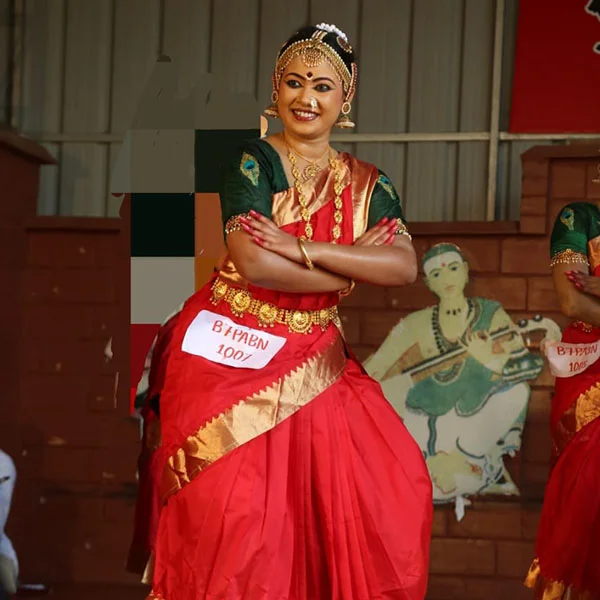
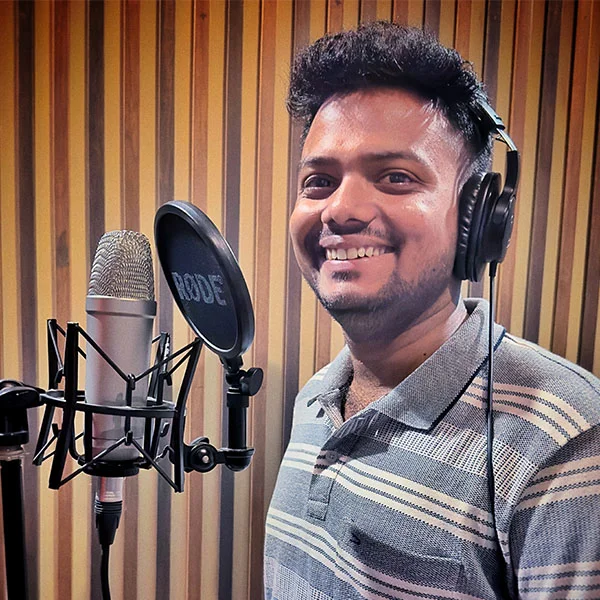
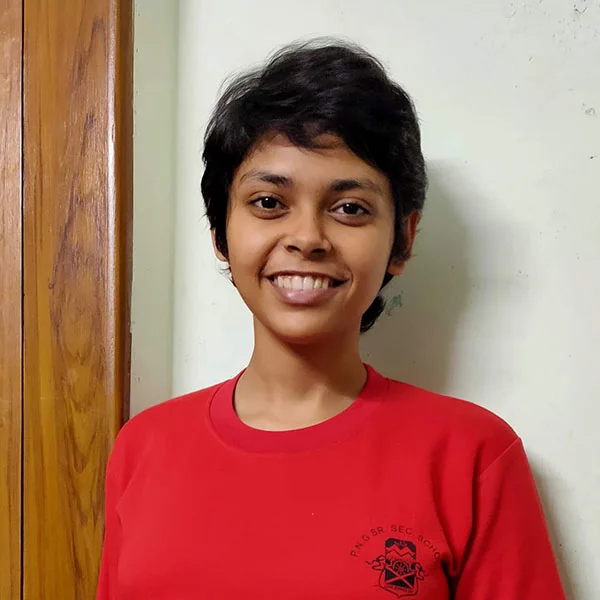
Expert educators who connect, guide, and prepare students with special personalized care ❤️📚✨












Student Achievements
Making an Impact: 🏆 Student Achievements That Shine | 🌱 Your Growth. Our Mission.




What Our Parents Say About Us
👪 Real Results. Real Parent Voices. 🏆 Futures Built with Care



Parent Testimonials
Success Stories That Speak 🌟🎓 Wins That Inspire Pride 🏆
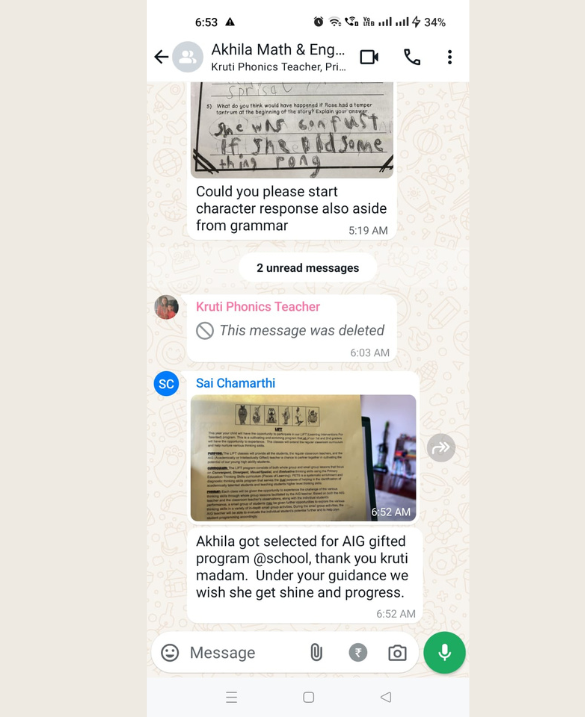
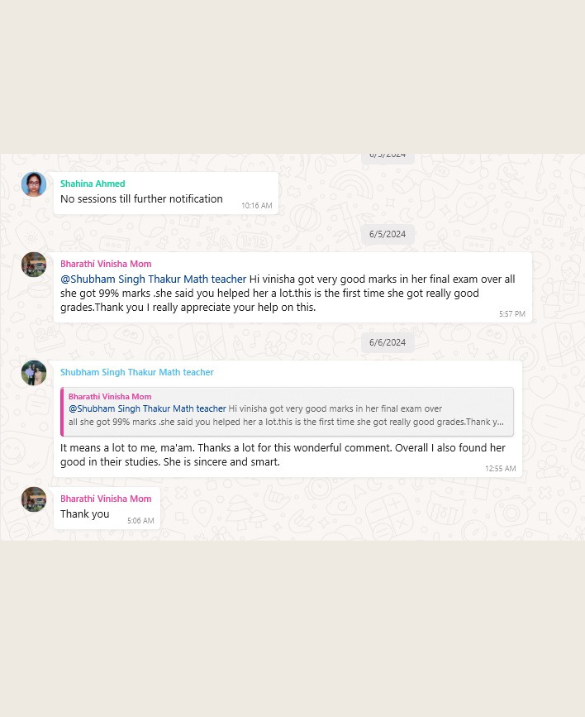
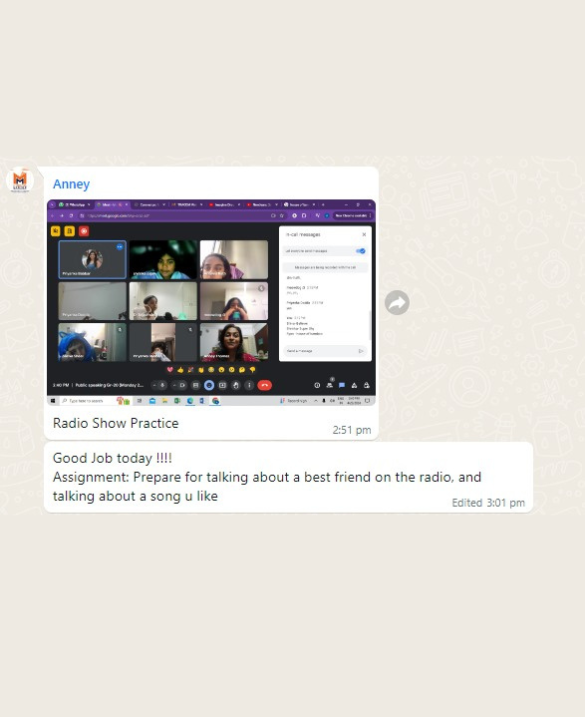
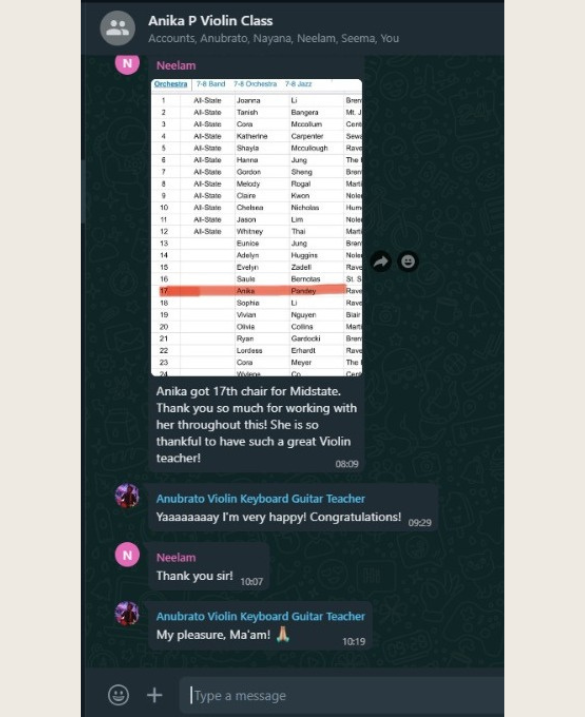
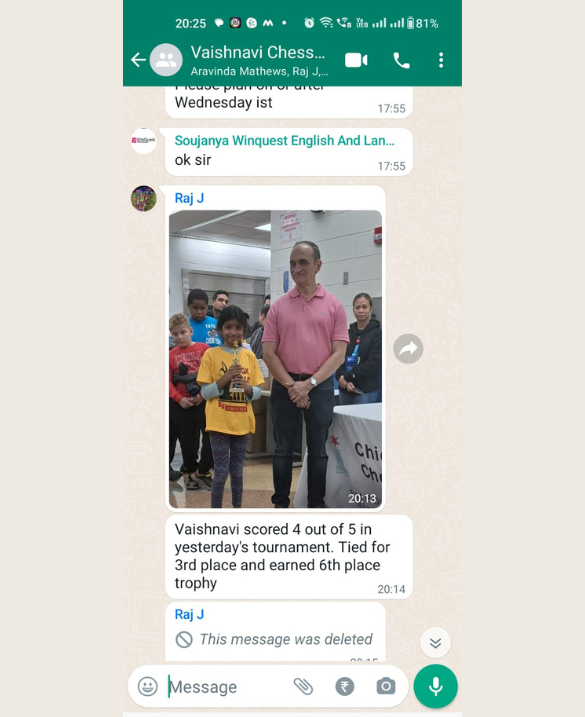
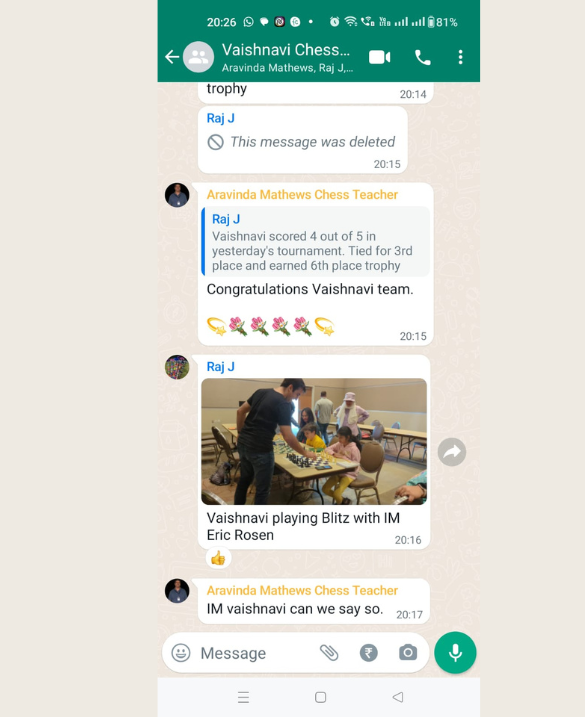
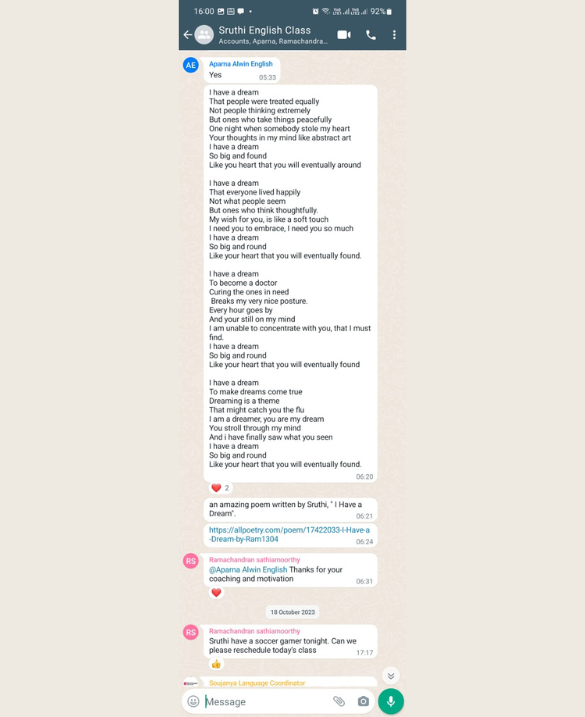
WhatsApp Testimonials
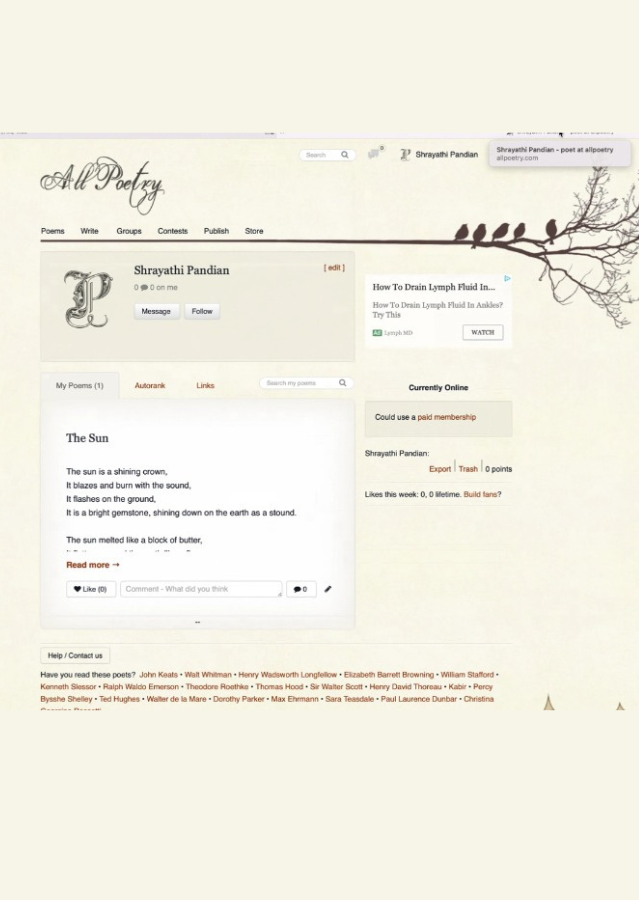
Real Voices from Our WhatsApp Community 💚📚








Latest News and Resources
📰 Learning Updates | 📘 Tips | 🎓 Resources | 💻 Online Courses