


Course Details
Mathematics Grade 8
Mathematics Grade 8
Why Choose Online Mathematics Grade 8 Classes?
Overview
Mathematics Grade 8 is the bridge year between primary math and high-school algebra and geometry. WinQuest delivers it 1:1 or in small groups aligned to your child's board - US Common Core 8, Canada (Ontario Grade 8), Australian v9.0 Year 8, CBSE Class 8, ICSE Class 8, Cambridge Lower Secondary Stage 8, IGCSE prep, or Singapore Secondary 2. Class structure is concept-build -> worked example -> graded worksheet -> chapter test.
What You'll Learn
- Live interactive sessions
- 1st one-on-one session
- Comprehensive curriculum
- No long-term commitment
- Personalized learning plan
Grade 8
The Number System+
- Rational and irrational numbers; decimal expansions - children understand that rational numbers have terminating or repeating decimals and irrational numbers do not.
- Approximate irrational numbers by rationals on a number line (e.g., sqrt(2) is approximately 1.41).
- Estimate and compare values of irrational expressions; recognise pi as irrational.
Expressions & Equations+
- Integer exponents and laws of exponents (e.g., 3^-2 = 1/9; (a^m)^n = a^(mn); a^m / a^n = a^(m-n)).
- Square roots and cube roots; scientific notation (a x 10^n where 1 <= a < 10) for very large or small numbers.
- Linear equations in one variable - finding one solution, no solution, or infinitely many solutions; systems of two linear equations.
Functions+
- Define, evaluate and compare functions - a function assigns exactly one output to each input; comparing properties of two functions (graphs, tables, equations).
- Linear vs non-linear functions; rate of change (slope) and initial value (y-intercept) of a linear function.
- Construct functions to model linear relationships from a description, a table, or two ordered pairs.
Geometry+
- Congruence and similarity using transformations - understanding that a series of rigid motions produces a congruent figure; dilations produce similar figures.
- Angle sum and exterior angles of triangles; angles formed by parallel lines cut by a transversal; angle-angle similarity criterion.
- Pythagorean theorem - proof and applications in 2-D and 3-D; volume of cylinders (V = pi r^2 h), cones (V = 1/3 pi r^2 h), spheres (V = 4/3 pi r^3).
Statistics & Probability+
- Bivariate data - constructing scatter plots, describing patterns (positive / negative / no association, linear / non-linear, outliers); line of best fit.
- Two-way tables for categorical data; calculating relative frequencies and identifying associations.
- Patterns of association in bivariate data; interpreting slope and intercept of the line of best fit in context.
Number Sense+
- Rational numbers - integers, fractions, decimals, percents; operations on all rational numbers including order of operations.
- Square and cube roots of perfect squares and cubes (sqrt(36) = 6; cbrt(27) = 3); approximation of non-perfect roots.
- Powers and exponents - including negative and zero exponents; scientific notation for very large and very small numbers.
Operations+
- Operations with rational numbers including order of operations (BEDMAS) with brackets, exponents and mixed operations.
- Estimation and mental math strategies including the use of benchmarks and compatible numbers.
- Multi-step problems involving percent (tax, discount, simple interest); finding original amount given discounted price.
Algebra & Coding+
- Linear relations - slope (rise / run or rate of change) and y-intercept (initial value); graphing y = mx + b.
- Solving linear equations with rational coefficients including variables on both sides; word problems leading to equations.
- Coding with conditional statements (if / else) and loops (for, while); using variables and functions in code.
Measurement & Geometry+
- Surface area and volume of prisms (rectangular, triangular) and cylinders using formulas.
- Pythagorean theorem applications in 2-D and 3-D real-world problems.
- Geometric transformations on the coordinate plane (translations, reflections, rotations, dilations) and their effects on coordinates.
Data & Probability+
- Histograms (continuous data with intervals), scatter plots (two-variable), circle graphs (parts of a whole).
- Measures of central tendency (mean, median, mode) and outliers; identifying how outliers affect each measure.
- Independent events (one doesn't affect the other - P(A and B) = P(A) x P(B)) and dependent events.
Number+
- Recognise irrational numbers (pi, sqrt(2), sqrt(3)) and estimate them between consecutive integers on a number line.
- Solve problems using percentages, ratios and rates including unit price and currency conversion.
- Apply index laws to numerical expressions (a^m x a^n = a^(m+n); (a^m)^n = a^(mn); a^0 = 1).
Algebra+
- Extend and apply distributive law to expand brackets including binomials (e.g., (x + 3)(x + 5) = x^2 + 8x + 15).
- Plot linear functions y = mx + c; solve linear equations including those with variables on both sides.
- Solve word problems leading to linear equations - representing the problem algebraically and interpreting the solution.
Measurement+
- Areas of trapeziums (1/2 x (a + b) x h), kites and rhombuses (1/2 x d1 x d2 product of diagonals).
- Volumes of prisms (V = base area x height); surface area of cylinders (2 pi r h + 2 pi r^2).
- Investigate the relationship between volume and capacity (1 cm^3 = 1 mL; 1000 cm^3 = 1 L).
Space+
- Establish properties of quadrilaterals using transformations (e.g., a rhombus is a parallelogram with all sides equal).
- Define congruence using transformations - figures are congruent if one can be transformed to the other using rigid motions.
- Use Pythagoras's theorem to find the length of an unknown side in a right-angled triangle.
Statistics+
- Distinguish between numerical (continuous, discrete) and categorical (nominal, ordinal) data; appropriate display for each.
- Construct stem-and-leaf plots, dot plots, frequency tables; interpret patterns.
- Calculate mean, median, mode and range; explain when each is most appropriate.
Probability+
- List sample spaces for single-step and two-step experiments; estimate probabilities from experimental data.
- Represent events using two-way tables and tree diagrams; calculate conditional probabilities.
- Compare theoretical and experimental probability; explain the convergence as the number of trials grows.
Rational Numbers & Exponents+
- Rational numbers - representation on the number line; properties (closure, commutative, associative, distributive).
- Operations on rational numbers - addition, subtraction, multiplication, division with proper, improper and mixed fractions.
- Exponents and powers - laws of exponents including negative exponents (a^-n = 1/a^n); applying to numerical and algebraic expressions.
Algebra+
- Algebraic expressions and identities - (a+b)^2 = a^2 + 2ab + b^2; (a-b)^2 = a^2 - 2ab + b^2; (a+b)(a-b) = a^2 - b^2.
- Factorisation methods - common factors, regrouping (factor by grouping), using algebraic identities.
- Linear equations in one variable - solving and applications including transposition method and word problems.
Geometry+
- Understanding quadrilaterals - sum of interior angles (360 deg), classification (parallelogram, rhombus, rectangle, square, trapezium, kite).
- Constructions of quadrilaterals given specified measurements (sides, angles, diagonals).
- Practical geometry; introduction to Euclid's definitions, postulates and axioms.
Mensuration+
- Area of trapezium and general quadrilateral by partitioning into triangles.
- Surface area and volume of cuboid (SA = 2(lb + bh + hl); V = lbh), cube (SA = 6s^2; V = s^3), cylinder (SA = 2 pi r(r+h); V = pi r^2 h).
- Application problems involving mensuration in real-life contexts.
Data Handling & Comparing Quantities+
- Bar graphs, histograms, pie charts; constructing pie charts using fractions / percentages and angle measure.
- Mean, median, mode of ungrouped data; representing data effectively.
- Discounts, profit / loss, simple interest, compound interest using the formula A = P(1 + R/100)^n.
Squares, Cubes & Graphs+
- Squares and square roots (perfect squares, finding square roots by division or prime factorisation); cubes and cube roots.
- Introduction to graphs - linear graphs, direct and inverse proportion.
- Playing with numbers - divisibility patterns, fun mathematical puzzles, applications.
Number System+
- Rational and irrational numbers; recognising irrational numbers like sqrt(2) and pi.
- Squares, cubes and their roots; methods of finding square roots (division method).
- Exponents and laws of exponents including negative and zero exponents.
Algebra+
- Algebraic expressions and identities - (a+b)^2, (a-b)^2, (a+b)(a-b), (x+a)(x+b).
- Factorisation of algebraic expressions using identities, common factors, grouping.
- Linear equations in one variable - solving and word problems including age, distance, work problems.
Geometry+
- Lines and angles; parallel lines cut by a transversal - angle properties (corresponding, alternate, co-interior).
- Triangles - construction (SSS, SAS, ASA, RHS), congruence and similarity.
- Quadrilaterals - construction and properties of parallelogram, rhombus, rectangle, square, trapezium.
Mensuration+
- Area of trapezium, parallelogram, rhombus using appropriate formulas.
- Surface area and volume of cuboid, cube, cylinder.
- Real-life mensuration problems involving tanks, water flow, cost of construction.
Commercial Mathematics+
- Profit, loss and discount calculations; using profit / loss percent formulas.
- Compound interest using A = P(1 + R/100)^n; comparison with simple interest.
- Direct and inverse variation; sales tax, value added tax (VAT) and GST applications.
Data Handling & Probability+
- Bar graphs, pie charts, frequency polygons - reading and constructing.
- Mean, median, mode of ungrouped and grouped data.
- Probability - simple events and equally likely events using P(E) = favourable / total outcomes.
Number+
- Square roots, cube roots and powers including the laws of indices.
- Rational numbers; recurring decimals and their fraction equivalents.
- Negative number arithmetic; order of operations (BIDMAS) with mixed positive and negative numbers.
Algebra+
- Construct, simplify and evaluate algebraic expressions using like terms and substitution.
- Solve linear equations (with variables on both sides) and linear inequalities.
- Use arithmetic sequences (e.g., 3, 7, 11, 15 - common difference 4) and geometric sequences (e.g., 2, 6, 18, 54 - common ratio 3).
Geometry & Measure+
- Properties of polygons - sum of interior angles ((n-2) x 180), regular polygons, tessellations.
- Area of triangles, parallelograms, trapeziums; volume of prisms (V = base area x height).
- Pythagoras's theorem - introduction; finding the length of an unknown side in a right-angled triangle.
Statistics+
- Display and interpret data using bar charts, pie charts, frequency diagrams and back-to-back stem-and-leaf plots.
- Calculate and interpret measures of central tendency (mean, median, mode) and spread (range).
- Plan and conduct a statistical investigation - question, hypothesis, data collection, analysis, conclusion.
Probability+
- Find probabilities of single events using P(E) = favourable / total outcomes.
- Use sample-space diagrams (lists, tables, tree diagrams) for two-step experiments.
- Compare experimental probability (from trials) and theoretical probability (calculated).
Numbers & Algebra+
- Real numbers and the number line including rational and irrational numbers.
- Algebraic manipulation - expansion of brackets and factorisation by grouping, common factors.
- Quadratic expressions - factorisation by various methods including cross method (the "Singapore Cross").
Equations & Inequalities+
- Solving linear equations including those with brackets and fractional coefficients; word problems.
- Solving fractional equations by clearing denominators and the LCM method.
- Linear inequalities and representing solutions on a number line.
Functions & Graphs+
- Coordinate geometry - distance between two points (using Pythagoras), gradient (slope).
- Linear functions y = mx + c; finding equation from two points or one point and slope.
- Plotting graphs of quadratic functions y = ax^2 + bx + c; identifying vertex, axis of symmetry.
Geometry+
- Congruence (SSS, SAS, ASA, RHS, SAA) and similarity (AA, SAS, SSS) of triangles.
- Pythagoras's theorem and applications including the converse.
- Properties of circles - chords (equal chords are equidistant from centre), tangents (tangent perpendicular to radius).
Mensuration+
- Area and perimeter of plane figures including composite shapes.
- Volume and surface area of pyramids (V = 1/3 base area x h), cones (V = 1/3 pi r^2 h), spheres (V = 4/3 pi r^3).
- Composite solids - calculating volume / surface area by adding / subtracting component shapes.
Statistics+
- Frequency distribution and histograms (with equal class widths).
- Mean, median, mode of grouped data using the mid-value of each class.
- Stem-and-leaf diagrams; back-to-back stem-and-leaf for comparing two data sets.
Bridge to IGCSE 0580+
- Solidify integer, fraction, decimal, percentage skills - the foundation of IGCSE Number topics.
- Algebra - expansion, factorisation, linear equations - essential before IGCSE Algebra & Graphs section.
- Geometry - angle facts, Pythagoras, mensuration - building blocks of IGCSE Geometry section.
IGCSE Mock Topics+
- Standard form (scientific notation) and ordinary notation interconversion.
- Simple coordinate geometry - midpoint, gradient, distance between points; linear graphs.
- Statistics - mean, median, mode, range of ungrouped data.
Note+
- For Grade 8, the Cambridge Lower Secondary Stage 8 framework above is used; this is the bridge year before IGCSE proper.
- Full IGCSE 0580 syllabus begins from Grade 9 (Cambridge Year 10) when the formal IGCSE 2-year course starts.
- See Mathematics Grade 9-10 for the full IGCSE 0580 syllabus and exam structure.
Requirements
- A laptop or desktop with stable internet
- A scientific calculator
- Notebook, geometry box, ruler, protractor
- School textbook (any board) - tutor will adapt to it
Reviews
4.95 / 5 ★ · 400+ students enrolled
Parents consistently rate our mentors for personalised attention, clear concepts and steady progress. Book a free demo to experience a class first-hand.
Frequently Asked Questions
How do I get started?+
Click the Book a Demo button on this page and fill in your child's grade and school board (CBSE / ICSE / IGCSE / Cambridge / US Common Core / Singapore MOE etc.). We will schedule a free trial session with a matching tutor. For details, contact our coordinator on WhatsApp at +91 93308 11581 or email contact@winquestonline.com.
Will the tutor follow my child's school board?+
Yes. Every WinQuest tutor is mapped to specific curricula. Before the first class we ask which board your child follows; the tutor uses that board's scope and sequence, supports the school textbook chapter by chapter, and adds worksheets in the board's exam style. We currently support US Common Core, Ontario, Australian v9.0, CBSE (NCERT), ICSE (CISCE), IGCSE 0580 / 0500 / 0610 / 0620 / 0625, Cambridge Primary / Lower Secondary, and Singapore MOE.
How does payment work?+
We require monthly advance payments for the number of classes scheduled in that calendar month. We accept Zelle, PayPal, UPI (for India), Stripe and major credit / debit cards. You can select your preferred payment method during the initial enrolment.
What if my child misses a class?+
For 1:1 sessions we reschedule a make-up at a mutually convenient time at no extra cost (with at least 24 hours notice). For group classes we share a timed recording of the session on parent request, so your child can catch up before the next class.
How long is each class?+
Each class session is 60 minutes long for academic subjects. Frequency is typically twice a week for K-7 grades and 2-3 times a week for high school, based on the board exam timeline and parent preference.
How is progress measured?+
Tutors give written feedback on every homework assignment, run a short formative quiz every 4-6 classes, and a longer chapter test at the end of each topic. Parents receive a monthly progress report covering concept mastery, homework completion and test scores.
What is the class size?+
For 1:1 sessions the class is just your child and the tutor. For group classes we cap each batch at 6-8 students so every learner gets individual attention and can ask questions in real time.
Are the tutors qualified?+
All our tutors are highly qualified subject-matter experts with proven track records - many hold Master's degrees in their subject and several years of school-curriculum teaching experience. Each tutor is interviewed by our academic head before joining and is mapped to specific boards and grades.
What if my child needs to pause for a school break or exam?+
Just let us know in advance. There are no contracts - you can pause for a school holiday or final-exam stretch and resume when the student is ready, with no penalty.
What are the requirements?+
A laptop or desktop with a stable internet connection is required. Pencil, eraser, ruler and a notebook for working out solved problems. For higher grades a basic calculator. The tutor will list any board-specific requirements (textbook, geometry box, etc.) before the first class.
Student Reviews
No reviews yet — be the first to share your experience with this course!
Meet our Teachers
Expert educators who connect, guide, and prepare students with special personalized care ❤️📚✨











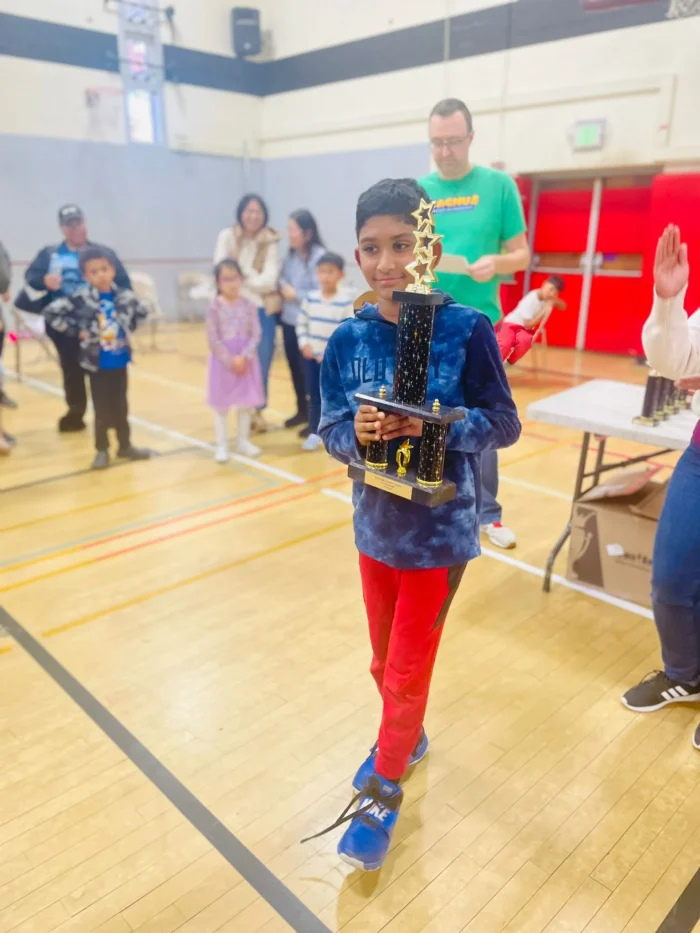
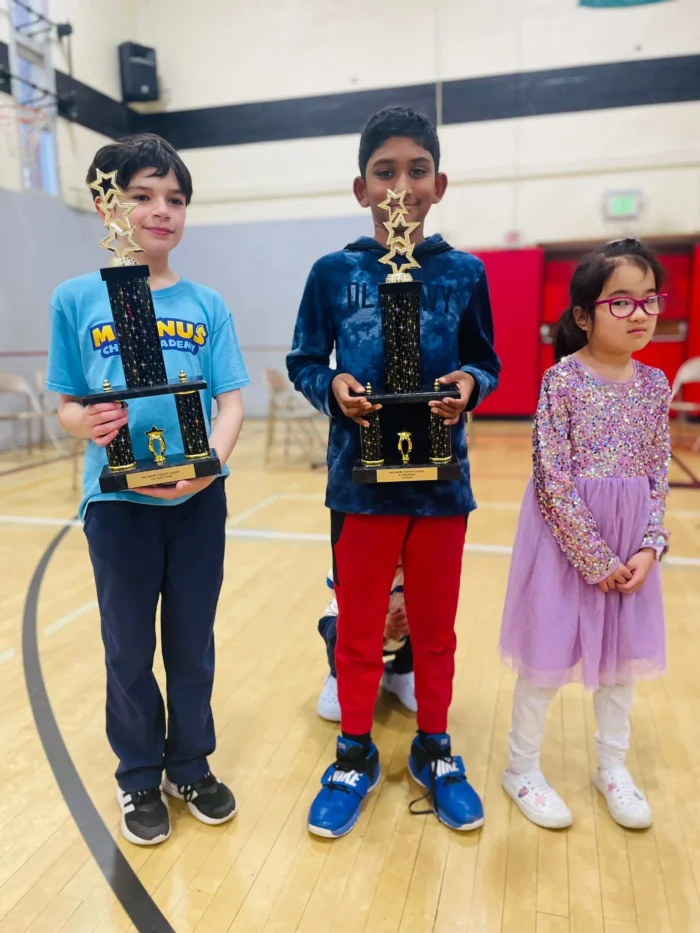
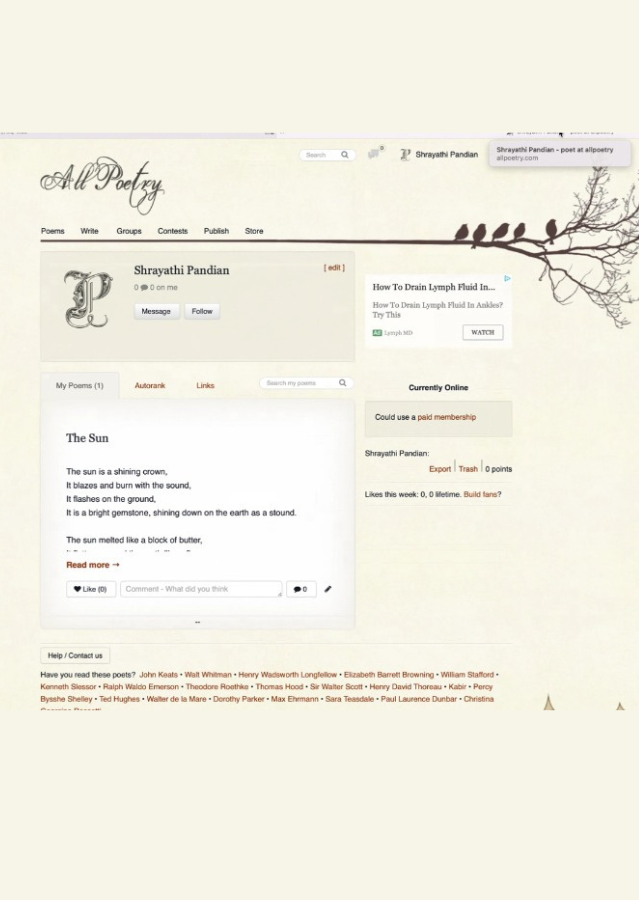
Student Achievements
Making an Impact: 🏆 Student Achievements That Shine | 🌱 Your Growth. Our Mission.


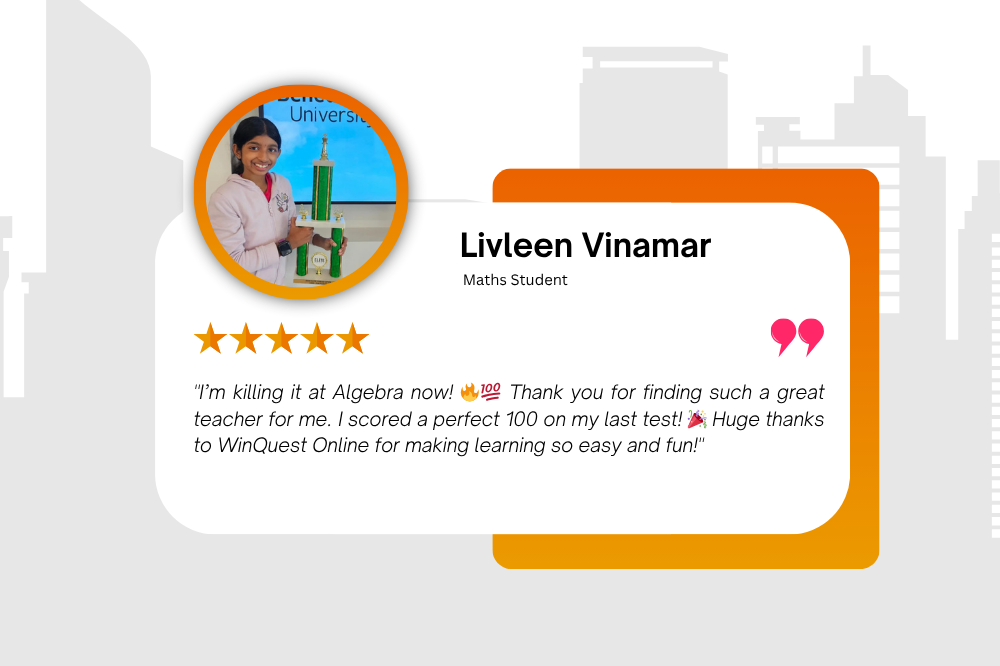
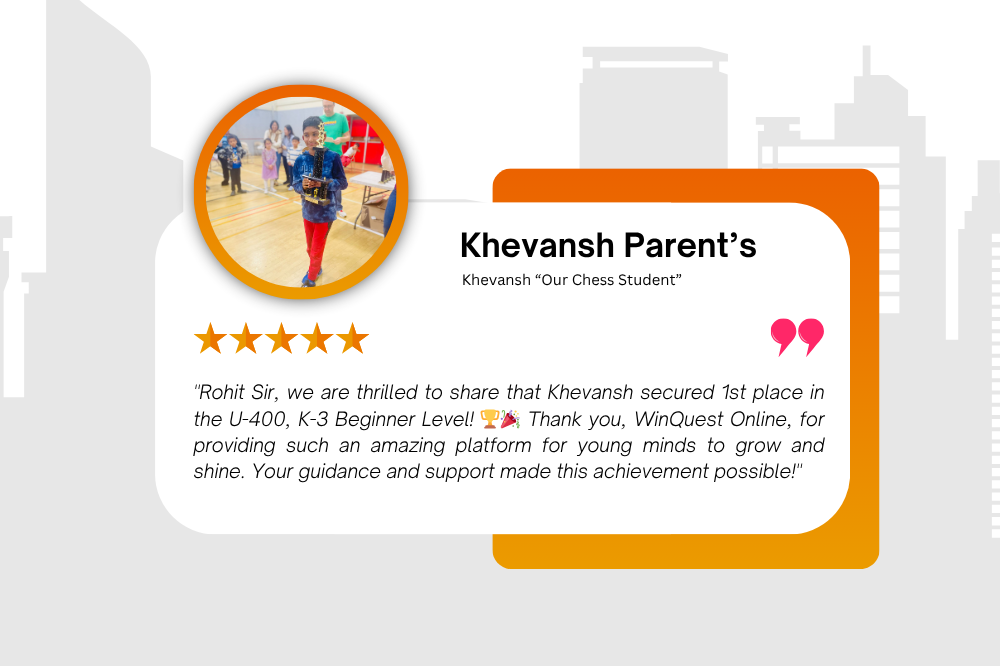
What Our Parents Say About Us
👪 Real Results. Real Parent Voices. 🏆 Futures Built with Care

Parent Testimonials
Success Stories That Speak 🌟🎓 Wins That Inspire Pride 🏆
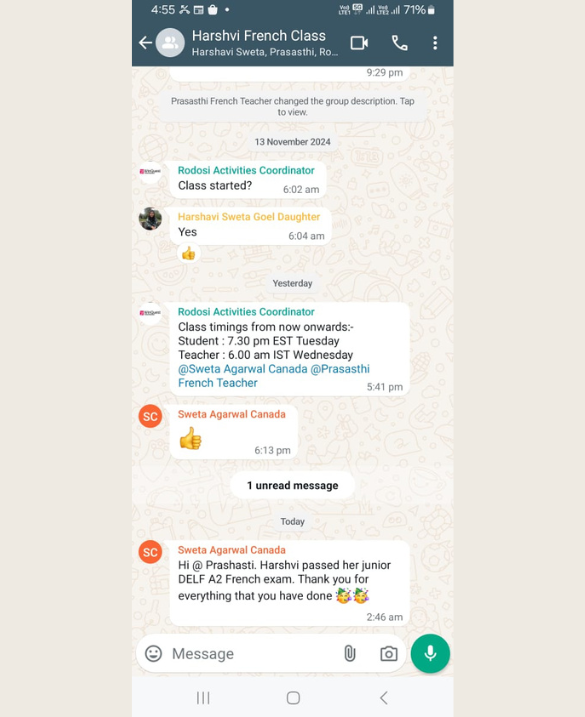
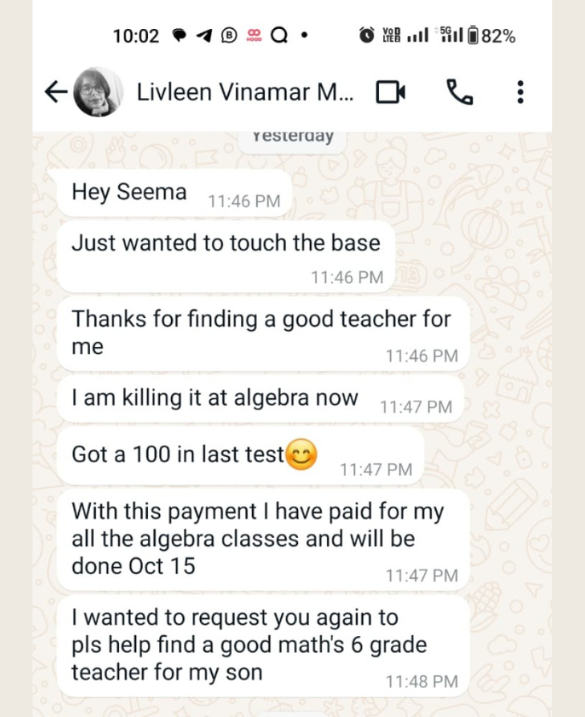
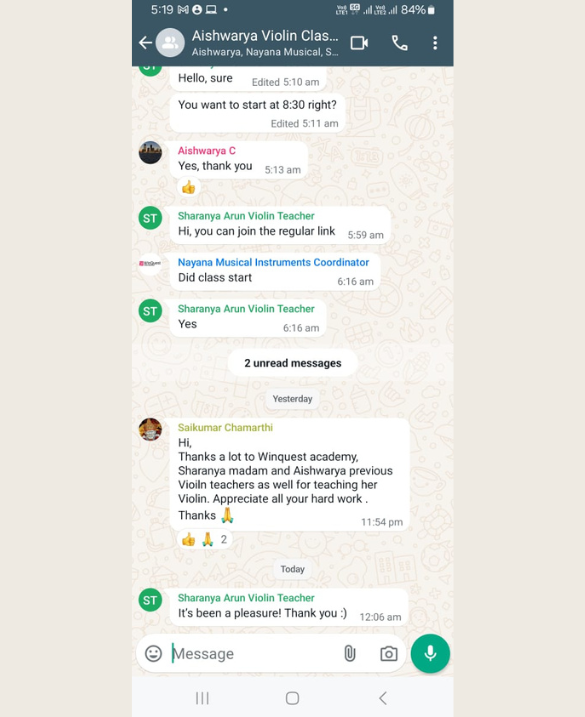
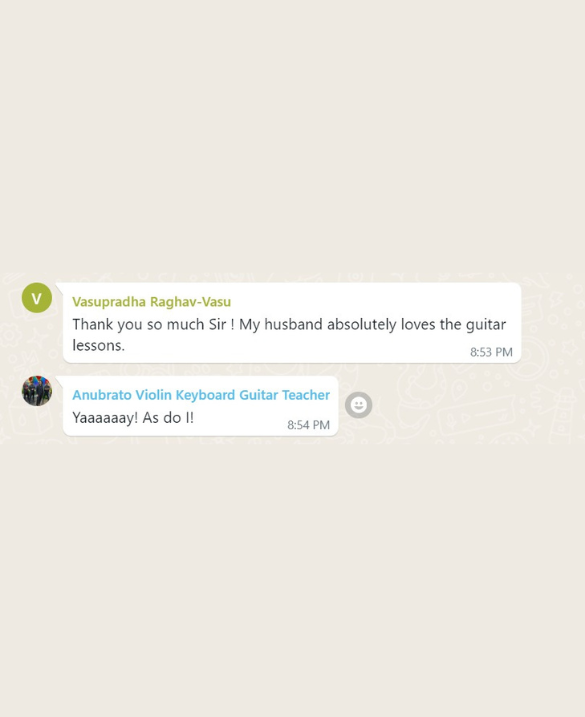
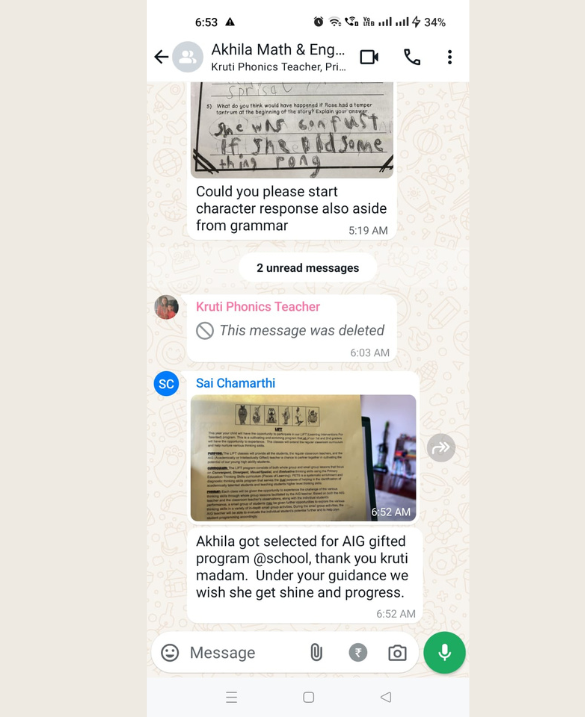
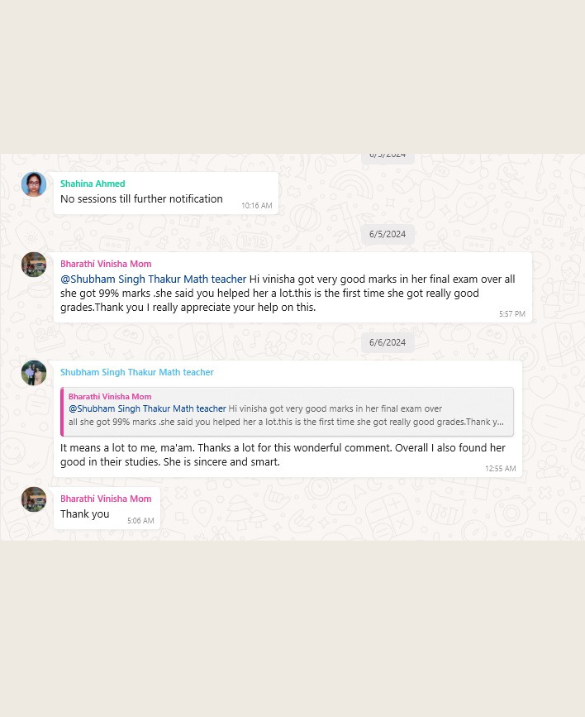
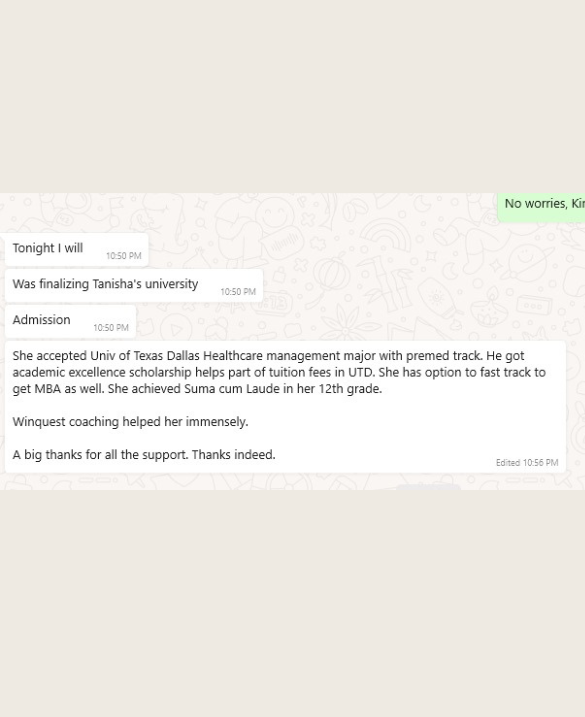
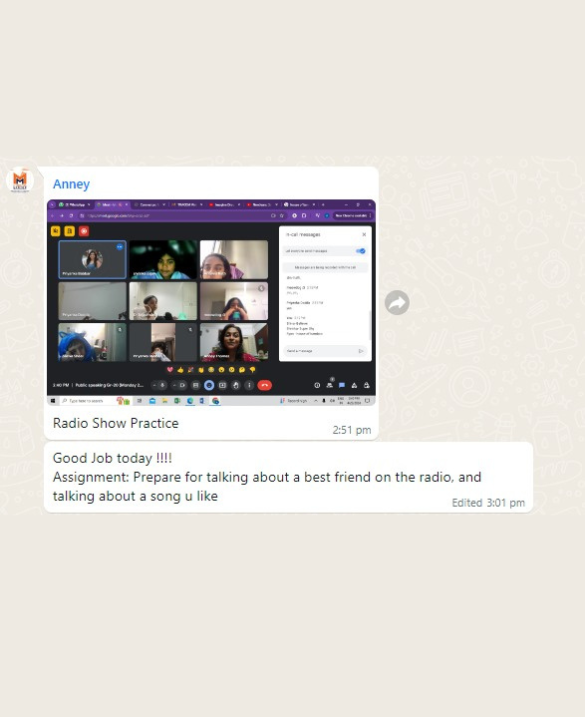
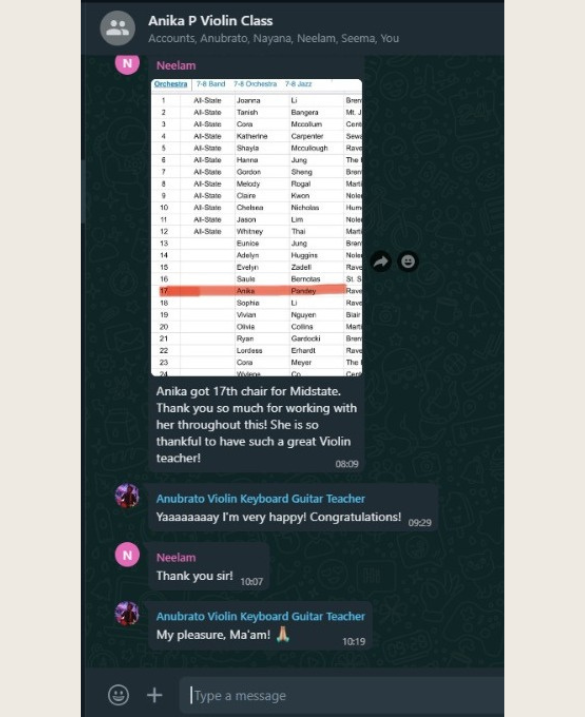
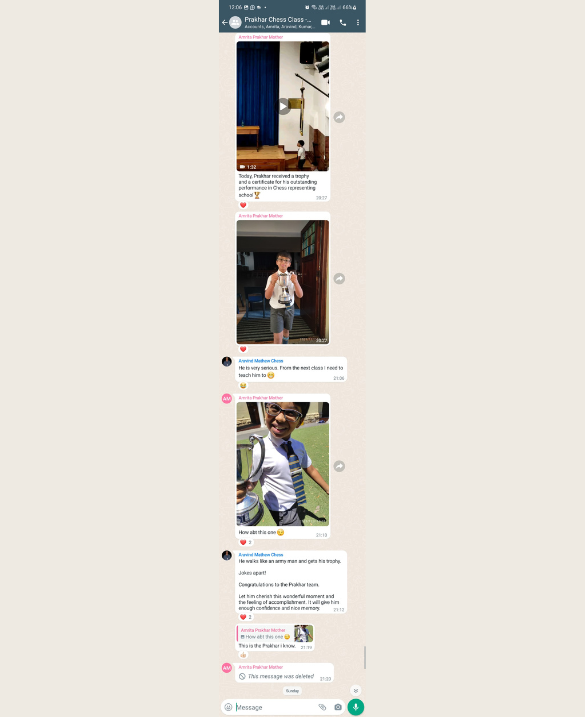
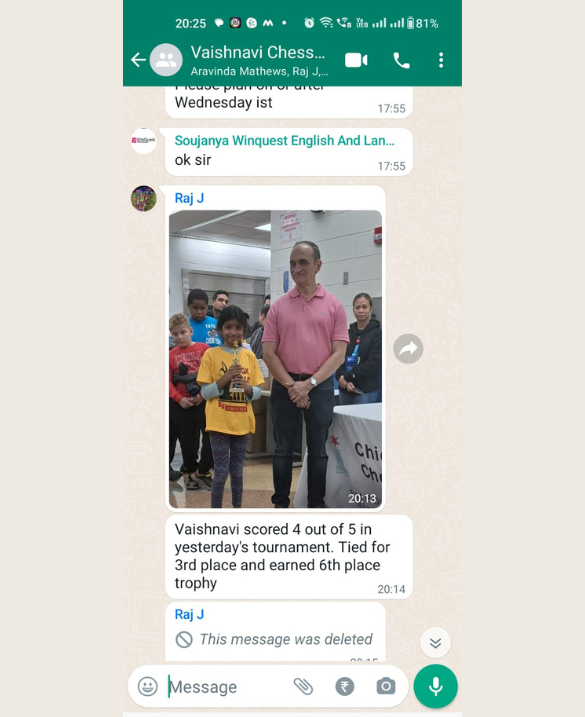
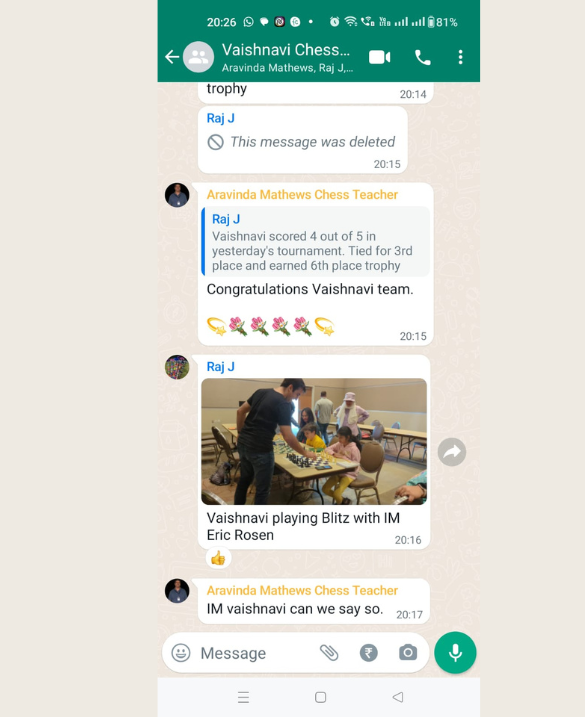
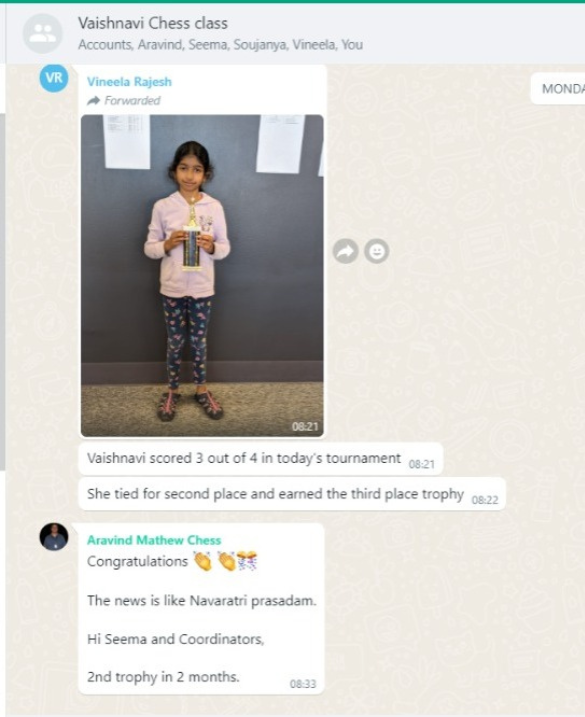
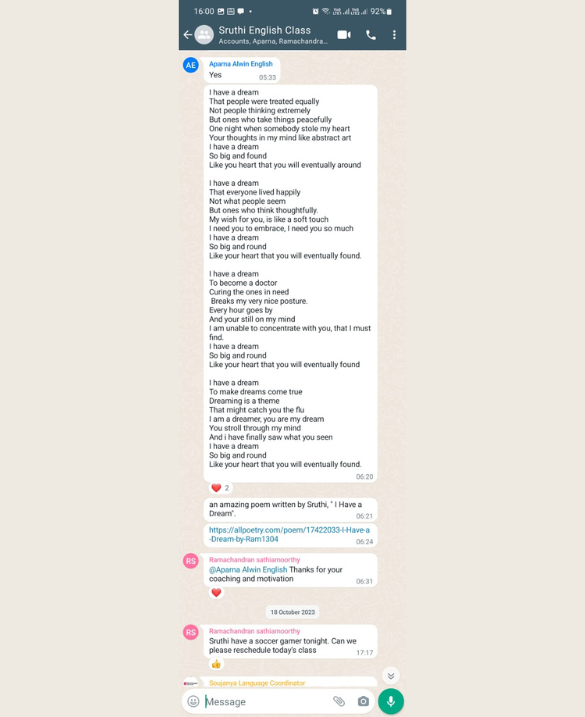
WhatsApp Testimonials
Real Voices from Our WhatsApp Community 💚📚
Latest News and Resources
📰 Learning Updates | 📘 Tips | 🎓 Resources | 💻 Online Courses