


Course Details
Physics Grade 11-12
Physics Grade 11-12
Why Choose Online Physics Grade 11-12 Classes?
Overview
Physics Grade 11-12 is senior-secondary Physics for the PCM / JEE / AP / IB / A-level stream. WinQuest delivers it 1:1 or in small groups aligned to your board - CBSE Class 11/12, ICSE ISC, Cambridge AS/A-level (9702), AP Physics 1+2 or C, Australian v9.0 Senior Physics, or Singapore H2 Physics.
What You'll Learn
- Live interactive sessions
- 1st one-on-one session
- Comprehensive curriculum
- No long-term commitment
- Personalized learning plan
Grade 11
Kinematics+
- Position (s, vector), velocity (v = ds/dt), acceleration (a = dv/dt); kinematics equations (v = u + at; s = ut + 1/2 at^2; v^2 = u^2 + 2as).
- Motion graphs (s-t, v-t, a-t; slope and area interpretations) and projectile motion (x = u cos theta . t; y = u sin theta . t - 1/2 gt^2).
- Relative motion - velocity of A relative to B = vA - vB; frames of reference; problems with boats, planes in moving fluids.
Dynamics - Newton's Laws+
- Forces (push/pull, vector quantity, measured in newtons) and free-body diagrams (drawing all forces acting on an object).
- Newton's three laws - 1st (F_net = 0 means a = 0; inertia), 2nd (F = ma; vectors), 3rd (every action has equal opposite reaction).
- Friction (mu_s N for static; mu_k N for kinetic), tension (force along strings / cables), normal force (perpendicular reaction).
Energy & Momentum+
- Work (W = F.d cos theta, joules), kinetic energy (KE = 1/2 mv^2), gravitational potential energy (PE = mgh), elastic PE (1/2 kx^2).
- Conservation of mechanical energy (KE + PE = constant in absence of non-conservative forces like friction).
- Impulse (J = F.t = dp; vector), momentum (p = mv); collisions - elastic (KE conserved) vs inelastic (KE not conserved).
Circular Motion & Rotation+
- Uniform circular motion - centripetal acceleration (a_c = v^2/r) and centripetal force (F_c = mv^2/r) directed towards centre.
- Torque (tau = r x F = rF sin theta) and rotational equilibrium (sum of torques = 0; sum of forces = 0).
- Angular momentum (L = r x p = I omega for rigid body); conservation of L when no external torque acts.
Kinematics+
- Linear motion - displacement (vector), velocity (rate of displacement change), acceleration (rate of velocity change).
- Two-dimensional motion and projectiles (horizontal: constant velocity; vertical: -g acceleration; parabolic path).
- Relative velocity - vector subtraction (v_AB = v_A - v_B); riverboat, headwind problems.
Forces+
- Newton's laws of motion - 1st (inertia: F_net = 0 -> a = 0), 2nd (F = ma), 3rd (action-reaction).
- Friction - static (object at rest; f_s <= mu_s N; coefficient of static friction) and kinetic (object moving; f_k = mu_k N).
- Forces in 2-D - inclined planes (resolve mg into mg sin theta along + mg cos theta perpendicular); pulleys.
Energy & Society+
- Work (W = F.d cos theta), energy (KE = 1/2 mv^2; PE = mgh), power (P = W/t; in watts).
- Conservation of energy (total energy in isolated system constant; transforms between forms but cannot be created / destroyed).
- Energy sources (renewable: solar, wind, hydro; non-renewable: fossil fuels, nuclear) and efficiency (useful output / total input).
Waves & Sound+
- Properties of waves - frequency (Hz), wavelength (m), amplitude, speed (v = f lambda), transverse vs longitudinal.
- Sound waves (longitudinal; need medium) and resonance (forced vibrations at natural frequency; e.g., wine glass).
- Doppler effect (apparent frequency change for relative motion between source + observer) and applications (radar, ultrasound, astronomy).
Kinematics & Dynamics+
- Vectors (have magnitude + direction: velocity, force) and scalars (magnitude only: speed, mass) in motion.
- Newton's laws (1st, 2nd: F = ma, 3rd: action-reaction) and friction (mu N; static vs kinetic; coefficient).
- Energy (W-KE theorem: W_net = dKE) and momentum (p = mv) conservation in isolated systems.
Thermal & Nuclear+
- Heat transfer - conduction (through solids; Q/t = kA dT/dx), convection (in fluids; density-driven), radiation (EM waves; Stefan-Boltzmann sigma T^4).
- Specific heat capacity (Q = mc dT; J / kg / K) and latent heat (Q = mL; energy for phase change without temperature change).
- Radioactive decay (N = N0 e^(-lambda t); alpha, beta, gamma) and half-life (t1/2 = ln 2 / lambda; time for half the nuclei to decay).
Waves & Thermodynamics+
- Wave properties - frequency (f, Hz), wavelength (lambda, m), speed (v = f lambda), period (T = 1/f).
- Sound waves (longitudinal; needs medium) and light waves (transverse EM; can travel in vacuum at c = 3 x 10^8 m/s).
- Refraction (bending at boundary; Snell's law: n1 sin theta1 = n2 sin theta2) and dispersion (white light -> rainbow via prism).
Electricity & Magnetism+
- DC circuits - Ohm's law (V = IR), Kirchhoff's rules (KCL: sum I_in = sum I_out; KVL: sum V around loop = 0).
- Magnetic fields (B in tesla) and the right-hand rule (current direction + B field direction -> force on charged particle direction).
- Electromagnetic induction - introduction (Faraday's law: EMF = -d Phi / dt; Lenz's law: induced current opposes flux change).
Mechanics+
- Units (SI: m, kg, s, A, K, mol, cd), dimensions (L, M, T; dimensional analysis), kinematics (motion equations).
- Newton's laws (1st: inertia, 2nd: F = ma, 3rd: action-reaction); friction (static, kinetic); work (W = F.d), energy (KE, PE), power (W/t).
- Systems of particles (centre of mass; momentum) and rotational motion (torque tau = r x F; moment of inertia I); gravitation (F = Gm1m2/r^2).
Properties of Matter & Heat+
- Mechanical properties of solids (Hooke's law F = kx; Young's modulus Y = stress / strain) and fluids (Pascal's law, Bernoulli's equation).
- Thermal properties of matter - thermal expansion (linear, area, volume; alpha, beta, gamma); specific heat capacity; latent heat.
- Thermodynamics - 1st law (Q = dU + W), 2nd law (entropy never decreases; heat engines have limited efficiency); processes (isothermal, adiabatic).
Oscillations & Waves+
- Simple harmonic motion - period (T = 2 pi sqrt(m/k) for spring; T = 2 pi sqrt(L/g) for pendulum), energy (E = 1/2 kA^2 max).
- Wave motion - longitudinal (compressions / rarefactions; sound) and transverse (perpendicular to motion; light, water waves).
- Sound waves (need medium; v = sqrt(B/rho) in solid; v = 343 m/s in air at 20C) and Doppler effect (f' = f (v +/- v_o) / (v +/- v_s)).
Kinetic Theory & Practical+
- Kinetic theory of gases - PV = NkT; average KE = 3/2 kT; rms speed v_rms = sqrt(3kT/m); pressure from molecular collisions.
- NCERT practical experiments - 12+ standardised experiments (Vernier callipers, screw gauge, beam balance, simple pendulum, etc.).
- Numerical problem-solving for boards / JEE - drilling MCQs + numericals; previous year JEE papers; conceptual problems.
Mechanics+
- Kinematics - 1D motion (v = u + at; s = ut + 1/2 at^2) and 2D motion (projectile motion; parabolic path).
- Newton's laws; circular motion (centripetal: a = v^2/r; F = mv^2/r); work (F.d) and energy (KE = 1/2 mv^2; PE).
- Rotational motion (torque tau = I alpha; angular momentum L = I omega) and rigid body dynamics (moment of inertia).
Gravitation & Properties of Matter+
- Gravitation - Newton's law (F = Gm1m2/r^2; G = 6.67 x 10^-11), Kepler's laws (orbits are ellipses; equal areas in equal times; T^2 proportional to a^3).
- Elasticity (Hooke's law F = kx; Young's modulus stress/strain) and pressure (P = F/A; Pascal's law; barometers).
- Surface tension (force per length; capillary action) and viscosity (resistance to flow; Stokes' law F = 6 pi eta rv).
Heat & Thermodynamics+
- Heat (energy transfer due to temperature difference) and temperature (Celsius, Kelvin; K = C + 273).
- Laws of thermodynamics - 0th (thermal equilibrium), 1st (Q = dU + W), 2nd (entropy increases), 3rd (S = 0 at T = 0 K).
- Heat engines (efficiency = W/Q_h = 1 - T_c/T_h for Carnot) and refrigerators (COP = Q_c / W).
Oscillations & Waves+
- Simple harmonic motion (a = -omega^2 x; T = 2 pi / omega; energy is conserved between KE and PE).
- Wave motion - properties (amplitude, frequency, wavelength, speed) and types (longitudinal, transverse, mechanical, EM).
- Sound (longitudinal; needs medium; v = 343 m/s in air) and Doppler effect (apparent frequency change due to relative motion).
Mechanics+
- Motion - kinematics (v = u + at; s = ut + 1/2 at^2; v^2 = u^2 + 2as) and dynamics (Newton's laws; F = ma).
- Forces (push/pull, vector), density (rho = m/V; kg/m^3), pressure (P = F/A; Pa = N/m^2).
- Work (W = F.d), energy (KE = 1/2 mv^2; PE = mgh), power (P = W/t), and momentum (p = mv; conservation).
Matter & Thermal Physics+
- Materials - elastic deformation (Hooke's law F = kx; strain energy = 1/2 Fx), Young's modulus (stress / strain).
- Waves - properties (frequency, wavelength, speed v = f lambda) and polarisation (only transverse waves can be polarised; Malus's law).
- Superposition - interference (constructive: path difference = n lambda; destructive: (n + 1/2) lambda) and diffraction (bending around obstacles).
Electricity+
- Charge (Q in coulombs; e = 1.6 x 10^-19 C), current (I = dQ/dt; ampere), voltage (V = W/Q; volt).
- DC circuits and Kirchhoff's rules - KCL (sum of currents at node = 0), KVL (sum of voltages around loop = 0).
- Resistance (R = V/I; ohm), resistivity (R = rho L/A; rho in ohm-m), internal resistance (battery EMF = IR + Ir).
Practical Skills+
- Measurement (significant figures, precision, accuracy) and uncertainty (absolute, fractional, percentage; propagation in calculations).
- Data analysis (mean, standard deviation, best-fit line) and graph plotting (axes, scales, error bars, gradient and intercept).
- AS Paper 3 practical exam practice - 2 hours; quantitative + qualitative tasks; lab skills; observations and conclusions.
Note+
- IGCSE 0625 Physics is sat at the end of Grade 10 / Year 11 in Cambridge schools.
- Cambridge AS-level (9702) Physics is taken in Grade 11 / Year 12 - half of full A-level qualification.
- See the Cambridge AS-level column above for the Grade 11 syllabus and exam structure.
Measurement & Kinematics+
- Physical quantities (scalar vs vector), SI units (m, kg, s, A, K, mol, cd), dimensions (L, M, T; dimensional analysis).
- Kinematics in 1D (v = u + at; s = ut + 1/2 at^2) and 2D (decompose into x and y components).
- Vectors (have magnitude + direction; head-to-tail addition; components) and projectile motion (parabolic path).
Dynamics & Energy+
- Newton's laws (1st: inertia, 2nd: F = ma, 3rd: action-reaction) and momentum (p = mv; conservation).
- Forces - friction (mu N; static vs kinetic), normal (perpendicular reaction), tension (along strings).
- Work (W = F.d cos theta), energy (KE = 1/2 mv^2; PE = mgh), power (P = W/t; W/s = watt).
Waves & Thermal+
- Wave motion (transverse, longitudinal; speed v = f lambda) and superposition (interference, standing waves).
- Sound (longitudinal; v = 343 m/s in air) and light (transverse EM; c = 3 x 10^8 m/s) - interference (Young's double slit), diffraction (single slit).
- Thermal physics - temperature (Celsius, Kelvin; K = C + 273), heat capacity (Q = mc dT), latent heat (Q = mL).
Practical Skills+
- Measurement (precision, accuracy, sig figs) and uncertainty (absolute, fractional, percentage; propagation).
- Lab experiments (designing, conducting, recording) and analysis (graphs, gradient, intercept, error bars).
- H2 Paper 4 practical exam practice - 2h30m; planning, analysis, evaluation; full lab skills assessment.
Grade 12
Electrostatics+
- Electric charge (Q in coulombs; e = 1.6 x 10^-19 C; quantised) and Coulomb's law (F = kq1q2/r^2; k = 8.99 x 10^9).
- Electric field (E = F/q; E = kQ/r^2 for point charge) and electric potential (V = W/q; V = kQ/r for point charge).
- Capacitors (Q = CV; energy U = 1/2 CV^2) and dielectrics (insert between plates; increase capacitance by factor K).
Circuits & Magnetism+
- DC circuits with capacitors (charging / discharging: V = V0 e^(-t/RC); time constant tau = RC) and inductors (L; back-EMF = -L dI/dt).
- Magnetic field (B in tesla; right-hand rule) and force on currents (F = BIL sin theta; on moving charge: F = qvB sin theta).
- Electromagnetic induction - Faraday (EMF = -d Phi/dt) and Lenz (induced current opposes flux change); applications: generators, transformers.
Waves, Optics & Modern Physics+
- Wave optics - interference (Young's double slit; fringe spacing y = lambda L/d), diffraction (single slit), polarisation (Malus's law).
- Photoelectric effect (E_photon = hf; KE_max = hf - phi; Einstein's 1905 work) and wave-particle duality (de Broglie lambda = h/p).
- Atomic models (Bohr: E_n = -13.6/n^2 eV; quantised orbits) and nuclear physics (alpha, beta, gamma decay; fission, fusion).
Fluid & Thermal Physics+
- Fluid statics (Pascal's law; hydrostatic pressure P = rho g h; buoyancy F_b = rho_fluid V g) and dynamics; Bernoulli's equation (P + 1/2 rho v^2 + rho gh = const).
- Kinetic theory of gases - PV = NkT; average KE = 3/2 kT; rms speed v_rms = sqrt(3RT/M); pressure from molecular collisions.
- Laws of thermodynamics (0th, 1st: Q = dU + W, 2nd: entropy increases, 3rd) and heat engines (Carnot efficiency = 1 - T_c/T_h).
Dynamics in Depth+
- Forces, momentum (p = mv) and energy (KE, PE) in 2D - resolve vectors into x, y components; conservation laws.
- Circular motion (a_c = v^2/r; F_c = mv^2/r) and gravitation (F = Gm1m2/r^2; orbital motion v = sqrt(GM/r)).
- Equilibrium (sum F = 0 and sum tau = 0) and rotational motion (tau = I alpha; L = I omega; rotational KE = 1/2 I omega^2).
Energy & Momentum+
- Work-energy theorem (W_net = dKE); collisions (elastic: KE conserved; inelastic: KE not conserved; perfectly inelastic: stick together).
- Conservation of energy (total energy in isolated system constant) and momentum (sum p_i = sum p_f when no external forces).
- Power (P = W/t = F.v; in watts) and efficiency (useful output / total input; expressed as percentage).
Electricity & Magnetism+
- Electric fields (E = F/q; E = kQ/r^2 for point charge) and potential (V = kQ/r; equipotentials; relation E = -dV/dr).
- Magnetic fields (B in tesla; F = qvB sin theta on moving charge; F = BIL sin theta on current-carrying wire) and EMF.
- Electromagnetic induction (Faraday's law EMF = -d Phi/dt; Lenz's law) and AC circuits (V = V0 sin(omega t); rms value = V0 / sqrt(2)).
Wave Nature & Modern Physics+
- Wave properties (frequency, wavelength, speed v = f lambda) and interference (constructive: in phase; destructive: out of phase).
- Photoelectric effect (E_photon = hf; KE_max = hf - phi) and matter waves (de Broglie lambda = h/p).
- Special relativity (postulates: speed of light constant; relativity of simultaneity) and nuclear physics (fission, fusion, mass-energy E = mc^2).
Motion & Gravitation+
- Projectile motion (parabolic; x = u cos theta . t; y = u sin theta . t - 1/2 gt^2) and circular motion (a_c = v^2/r; F_c = mv^2/r).
- Gravitational fields (g = F/m; g = GM/r^2) and orbital motion (v = sqrt(GM/r); T^2 = (4 pi^2 / GM) r^3 - Kepler's 3rd law).
- Energy and momentum in collisions - elastic (KE conserved) vs inelastic (KE not conserved; perfectly inelastic: stick together).
Electromagnetism+
- Electric fields - parallel plates (E = V/d, uniform between plates), point charges (E = kQ/r^2, radial).
- Magnetic fields (B in tesla) and forces on currents (F = BIL sin theta; right-hand rule for direction).
- Electromagnetic induction - Faraday (EMF = -d Phi/dt; rate of flux change) and Lenz (induced current opposes flux change).
Light & Modern Physics+
- Wave model of light - interference (Young's double slit; fringe spacing y = lambda L/d) and diffraction (single slit; grating).
- Particle model - photoelectric effect (light as photons E = hf; KE_max = hf - phi); Einstein's 1905 paper.
- Quantum (wave-particle duality, de Broglie lambda = h/p) and nuclear physics intro (radioactive decay, half-life, fission).
Special Relativity (Option)+
- Postulates of special relativity - laws of physics same in all inertial frames; speed of light c is constant in all frames.
- Time dilation (moving clocks run slow; t = t0 / sqrt(1 - v^2/c^2)) and length contraction (L = L0 sqrt(1 - v^2/c^2)).
- Mass-energy equivalence (E = mc^2); rest energy + kinetic energy; applications in nuclear physics.
Electrostatics & Current Electricity+
- Electric charges (Q in coulombs; e = 1.6 x 10^-19 C) and fields (E = F/q; Coulomb's law F = kq1q2/r^2; Gauss's law).
- Electrostatic potential (V = W/q; V = kQ/r for point charge) and capacitance (C = Q/V; C of parallel plates = epsilon_0 A/d).
- Current electricity - Ohm's law (V = IR), circuits (series + parallel combinations), Kirchhoff's rules.
Magnetism, Induction & AC+
- Moving charges and magnetism - F = qvB sin theta on charge; F = BIL sin theta on current-carrying wire; right-hand rule.
- Magnetism and matter - magnetic dipole moment; magnetisation; paramagnetism, diamagnetism, ferromagnetism.
- Electromagnetic induction (Faraday's law EMF = -d Phi/dt; Lenz's law); alternating current (V = V0 sin omega t; rms; transformers).
Optics & Wave Optics+
- Ray optics (reflection: angle of i = r; refraction: Snell's law n1 sin theta1 = n2 sin theta2) and optical instruments.
- Wave optics - interference (Young's double slit y = lambda L/d), diffraction (single slit, grating), polarisation (Malus's law).
- Lenses (1/f = 1/v - 1/u; m = v/u), microscope (compound; magnification), telescope (refracting + reflecting).
Modern Physics+
- Dual nature of radiation (photons) and matter (de Broglie waves lambda = h/p; wave-particle duality).
- Atoms - Bohr model (E_n = -13.6/n^2 eV; quantised orbits); nuclei - fission (heavy -> light + energy) and fusion (light -> heavy + energy).
- Semiconductor electronics (p-n junction; diodes; transistors as amplifiers / switches); communication systems (modulation: AM, FM).
Electrostatics & DC Circuits+
- Electric charges, fields (E = F/q; F = kq1q2/r^2 Coulomb's law), Gauss's law (Phi_E = Q_enc / epsilon_0).
- Capacitance (C = Q/V; parallel plate C = epsilon_0 A/d) and dielectrics (insert -> C increases by K factor).
- DC circuits (series + parallel) and Kirchhoff's laws (KCL: sum I = 0 at node; KVL: sum V = 0 around loop).
Magnetism, Induction & AC+
- Moving charges in magnetic fields - F = qvB sin theta; circular motion of charged particle in field; mass spectrometer.
- Electromagnetic induction - Faraday's law (EMF = -d Phi/dt), Lenz's law, self + mutual induction.
- Alternating current circuits - V = V0 sin(omega t); rms values; impedance Z; resonance; transformers.
Optics+
- Reflection (angle of i = r), refraction (Snell's law); lenses (convex, concave; 1/f = 1/v - 1/u), mirrors (concave, convex).
- Wave optics - interference (Young's double slit y = lambda L/d), diffraction (single slit, grating; angular width).
- Optical instruments - human eye, magnifying glass, microscope (compound; angular magnification), telescope (astronomical).
Modern Physics+
- Photoelectric effect (KE_max = hf - phi; threshold frequency; Einstein's explanation) and wave-particle duality (de Broglie lambda = h/p).
- Atomic physics (Bohr model; E_n = -13.6/n^2 eV; emission + absorption spectra) and nuclear physics (alpha, beta, gamma decay; fission, fusion).
- Semiconductor diodes (p-n junction; forward bias allows current; reverse bias blocks) and transistors (NPN, PNP; amplifier, switch).
Circular Motion, Gravitation, Oscillations+
- Circular motion - radians (2 pi rad = 360 deg), angular velocity (omega = d theta/dt; v = r omega), centripetal acceleration.
- Gravitational fields - Newton's law of gravitation (F = Gm1m2/r^2; G = 6.67 x 10^-11), satellite motion (v = sqrt(GM/r); geostationary T = 24h).
- Oscillations - SHM (a = -omega^2 x; T = 2 pi/omega), energy in SHM (E = 1/2 m omega^2 A^2), damping (under, critical, over).
Thermal & Ideal Gases+
- Ideal gases - kinetic theory (PV = NkT; average KE = 3/2 kT; v_rms = sqrt(3RT/M)).
- Thermodynamics - first law (Q = dU + W; energy conserved), internal energy U (depends only on T for ideal gas).
- Heat capacity (C = Q/dT; specific heat c = Q/m dT) and latent heat (Q = mL; energy for phase change at constant T).
Electric, Magnetic & Quantum+
- Coulomb's law (F = kq1q2/r^2; k = 8.99 x 10^9) and electric fields (E = F/q; E = kQ/r^2 for point charge).
- Capacitance (C = Q/V; parallel plate C = epsilon_0 A/d) and magnetic fields (B in tesla; F = BIL on wire; F = qvB on charge).
- Quantum physics - photoelectric effect (KE_max = hf - phi), atomic energy levels (Bohr E_n = -13.6/n^2 eV; quantised).
Past Paper Practice+
- 4 Paper 4 (theory; 2 hours; 100 marks) and Paper 5 (planning + analysis + evaluation; 1h15m; 30 marks) mocks.
- A* targeting (>= 90%); time management (90 min / paper); precise answers with units, sig figs, ray + circuit diagrams.
- May / October session preparation - past papers from 5+ years; examiner reports; common mistakes.
Note+
- IGCSE 0625 Physics is sat at the end of Grade 10 / Year 11 in Cambridge schools.
- Cambridge A-level (9702) Physics is taken in Grade 12 / Year 13 - full A-level qualification (AS + A2 papers).
- See the Cambridge A-level column above for the Grade 12 syllabus and exam structure.
Oscillations & Waves+
- SHM (a = -omega^2 x; T = 2 pi/omega) and energy in SHM (E = 1/2 m omega^2 A^2; KE + PE = constant).
- Wave superposition - interference (constructive: path diff = n lambda; destructive: (n + 1/2) lambda), diffraction (bending around obstacles), polarisation.
- Coherence (constant phase relationship) and standing waves (fixed nodes + antinodes; on strings, in pipes).
Electromagnetism+
- Electric fields - Coulomb's law (F = kq1q2/r^2), E = F/q, potential V = kQ/r, capacitance C = Q/V.
- Magnetic fields (B in tesla) and forces (F = BIL on current-carrying wire; F = qvB sin theta on moving charge).
- Electromagnetic induction (Faraday's + Lenz's laws) and AC (V = V0 sin omega t; rms; transformers V_p/V_s = N_p/N_s).
Quantum & Nuclear Physics+
- Photoelectric effect (KE_max = hf - phi; threshold f_0 = phi/h) and wave-particle duality (de Broglie lambda = h/p).
- Atomic models - Bohr (E_n = -13.6/n^2 eV; quantised orbits); spectra (emission, absorption; Balmer, Lyman series).
- Nuclear physics - decay (alpha, beta, gamma; N = N0 e^(-lambda t); t1/2 = ln 2 / lambda), binding energy per nucleon (Fe peak).
Exam Preparation+
- TYS (Ten-Year Series) past papers - drilling each year's questions for pattern recognition.
- Paper 1 (MCQ; 1 hour, 30 questions), Paper 2 (structured; 2 hours), Paper 3 (free response; 2 hours), Paper 4 (practical; 2h30m).
- A-grade target writing - precise terminology, complete answers with units, diagrams labelled, sig figs.
Requirements
- A laptop or desktop with stable internet
- Scientific calculator (graphing calc for AP / A-level)
- Notebook for equations, ray diagrams, circuit diagrams
- School Physics textbook + past papers
Reviews
4.95 / 5 ★ · 300+ students enrolled
Parents consistently rate our mentors for personalised attention, clear concepts and steady progress. Book a free demo to experience a class first-hand.
Frequently Asked Questions
How do I get started?+
Click the Book a Demo button on this page and fill in your child's grade and school board (CBSE / ICSE / IGCSE / Cambridge / US Common Core / Singapore MOE etc.). We will schedule a free trial session with a matching tutor. For details, contact our coordinator on WhatsApp at +91 93308 11581 or email contact@winquestonline.com.
Will the tutor follow my child's school board?+
Yes. Every WinQuest tutor is mapped to specific curricula. Before the first class we ask which board your child follows; the tutor uses that board's scope and sequence, supports the school textbook chapter by chapter, and adds worksheets in the board's exam style. We currently support US Common Core, Ontario, Australian v9.0, CBSE (NCERT), ICSE (CISCE), IGCSE 0580 / 0500 / 0610 / 0620 / 0625, Cambridge Primary / Lower Secondary, and Singapore MOE.
How does payment work?+
We require monthly advance payments for the number of classes scheduled in that calendar month. We accept Zelle, PayPal, UPI (for India), Stripe and major credit / debit cards. You can select your preferred payment method during the initial enrolment.
What if my child misses a class?+
For 1:1 sessions we reschedule a make-up at a mutually convenient time at no extra cost (with at least 24 hours notice). For group classes we share a timed recording of the session on parent request, so your child can catch up before the next class.
How long is each class?+
Each class session is 60 minutes long for academic subjects. Frequency is typically twice a week for K-7 grades and 2-3 times a week for high school, based on the board exam timeline and parent preference.
How is progress measured?+
Tutors give written feedback on every homework assignment, run a short formative quiz every 4-6 classes, and a longer chapter test at the end of each topic. Parents receive a monthly progress report covering concept mastery, homework completion and test scores.
What is the class size?+
For 1:1 sessions the class is just your child and the tutor. For group classes we cap each batch at 6-8 students so every learner gets individual attention and can ask questions in real time.
Are the tutors qualified?+
All our tutors are highly qualified subject-matter experts with proven track records - many hold Master's degrees in their subject and several years of school-curriculum teaching experience. Each tutor is interviewed by our academic head before joining and is mapped to specific boards and grades.
What if my child needs to pause for a school break or exam?+
Just let us know in advance. There are no contracts - you can pause for a school holiday or final-exam stretch and resume when the student is ready, with no penalty.
What are the requirements?+
A laptop or desktop with a stable internet connection is required. Pencil, eraser, ruler and a notebook for working out solved problems. For higher grades a basic calculator. The tutor will list any board-specific requirements (textbook, geometry box, etc.) before the first class.
Student Reviews
No reviews yet — be the first to share your experience with this course!
Meet our Teachers
Expert educators who connect, guide, and prepare students with special personalized care ❤️📚✨












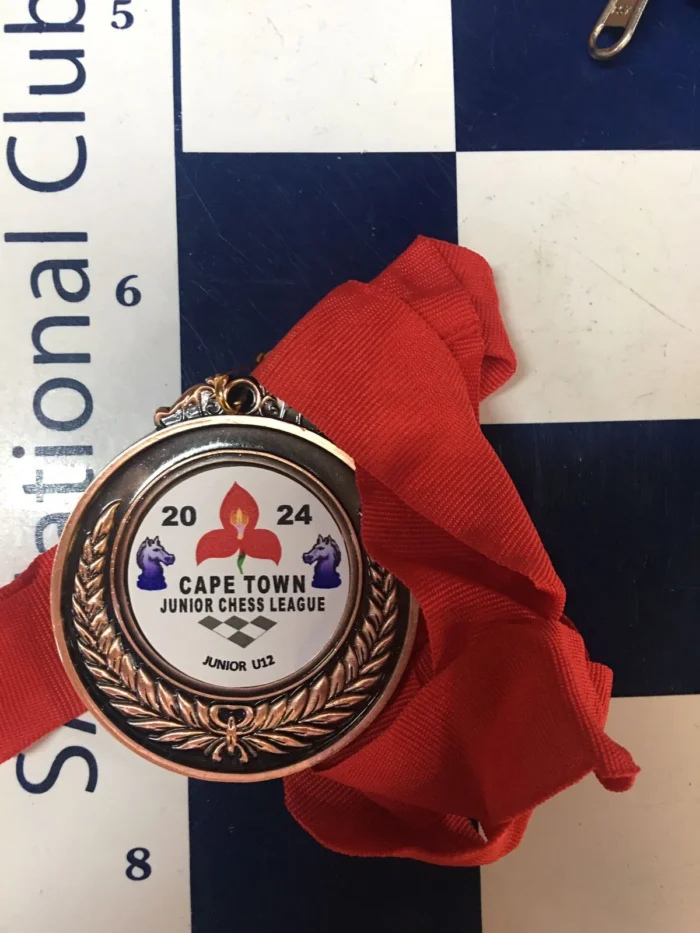
Student Achievements
Making an Impact: 🏆 Student Achievements That Shine | 🌱 Your Growth. Our Mission.



What Our Parents Say About Us
👪 Real Results. Real Parent Voices. 🏆 Futures Built with Care


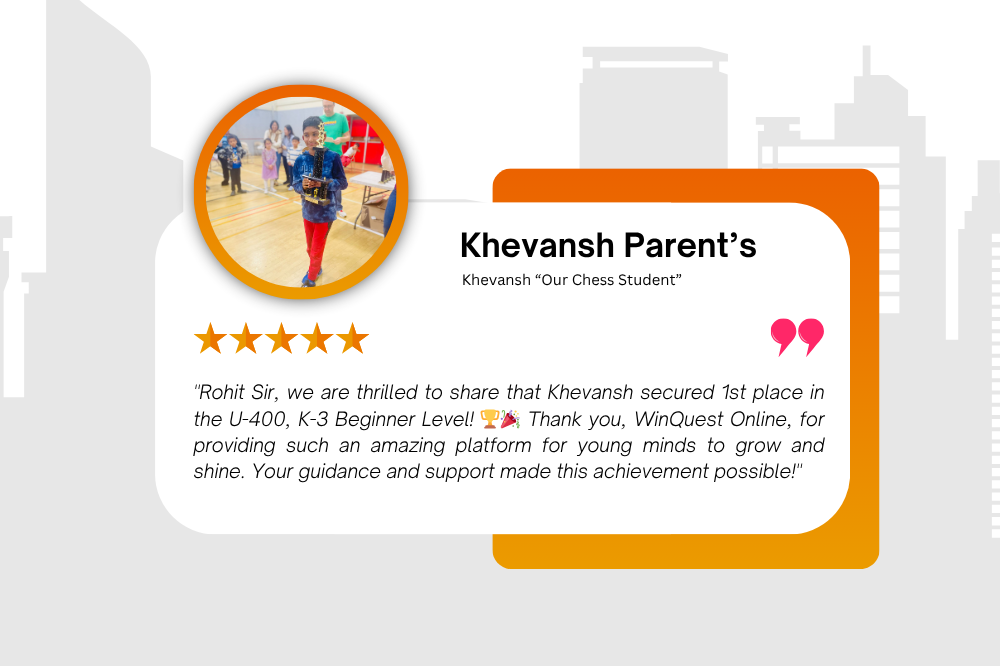
Parent Testimonials
Success Stories That Speak 🌟🎓 Wins That Inspire Pride 🏆
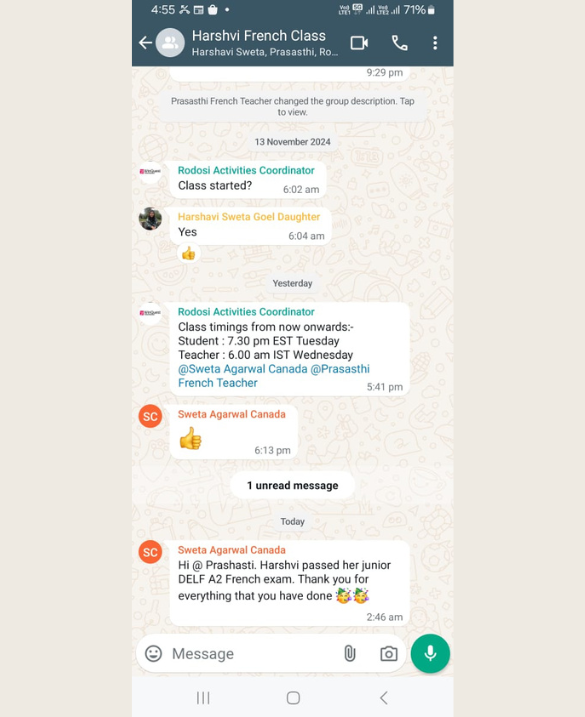
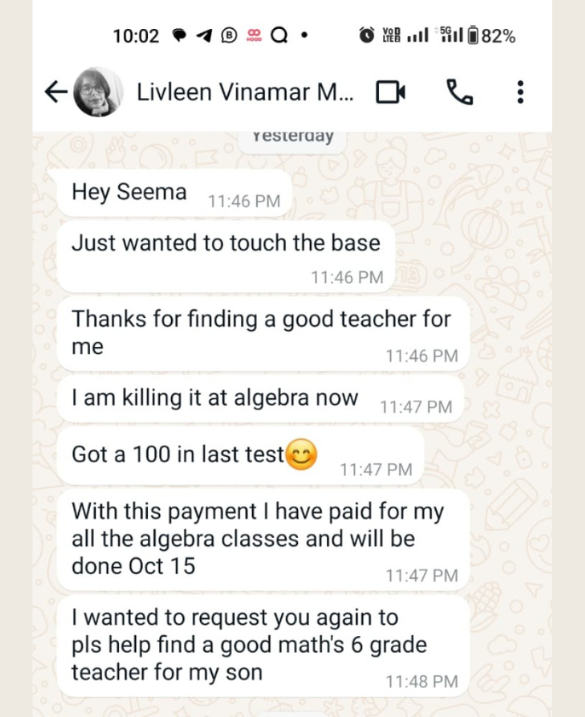
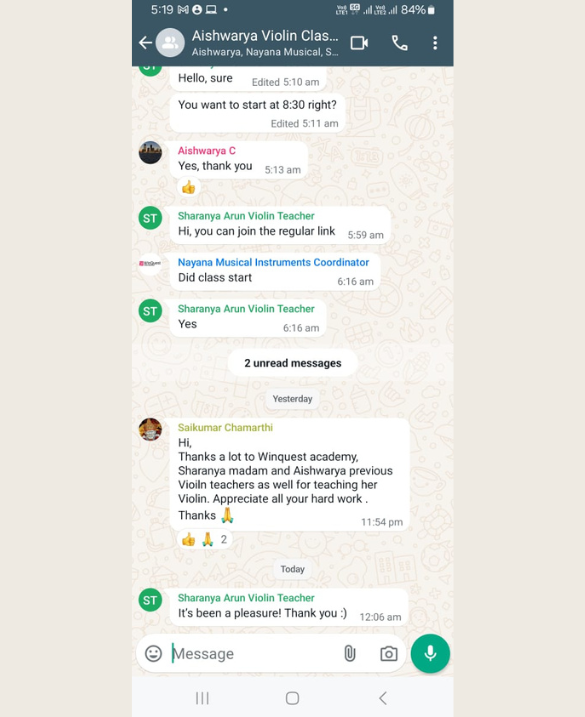
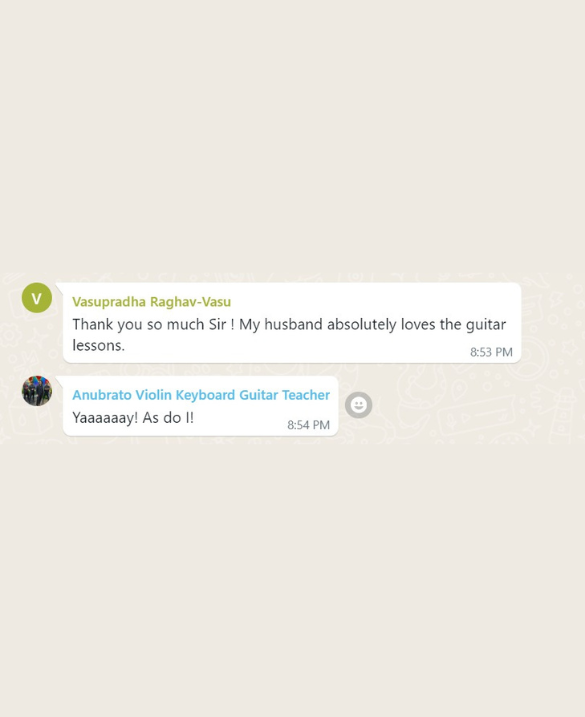
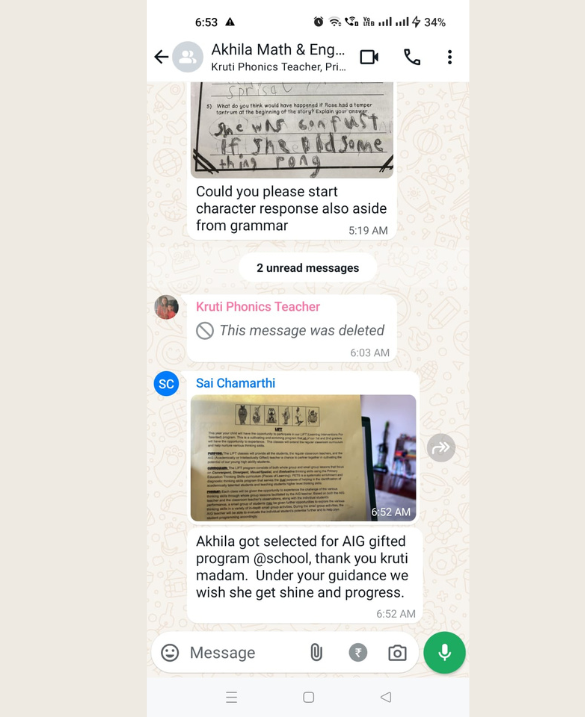
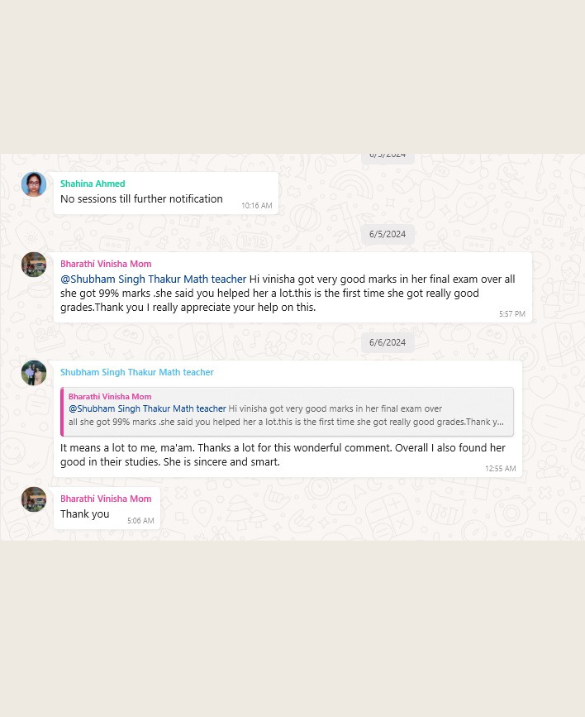
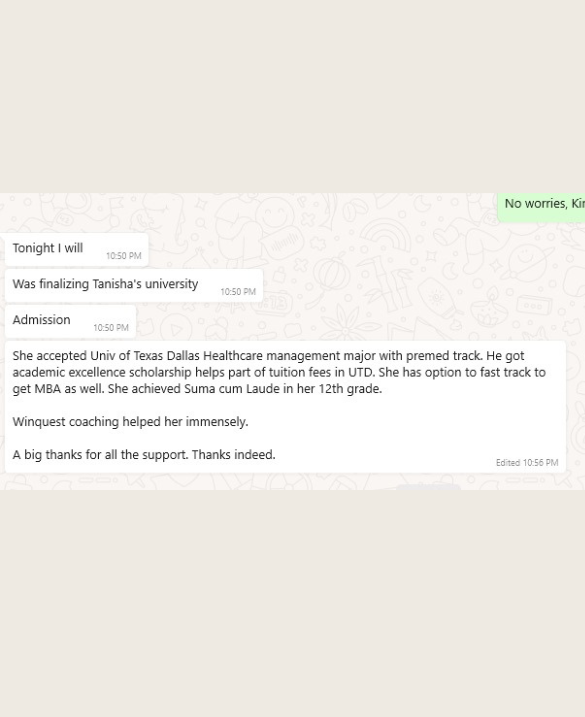
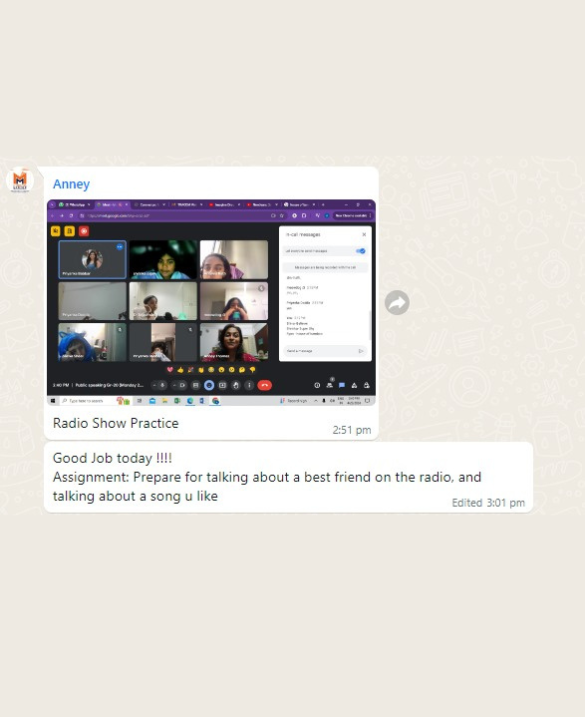
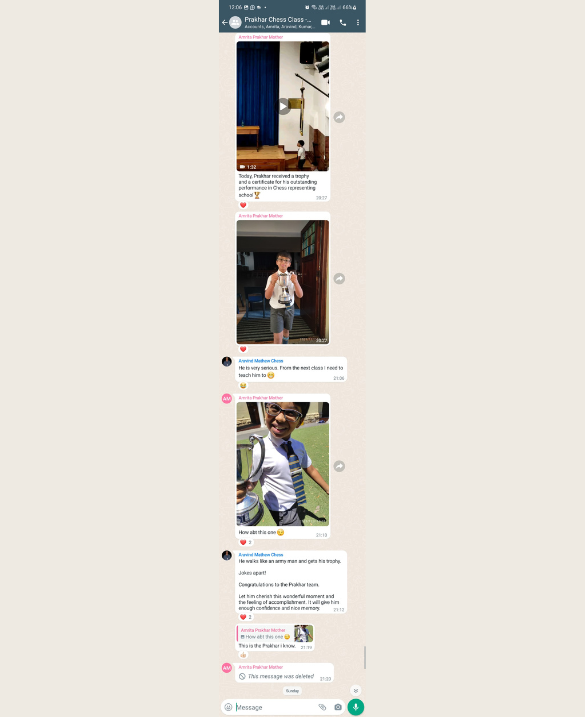
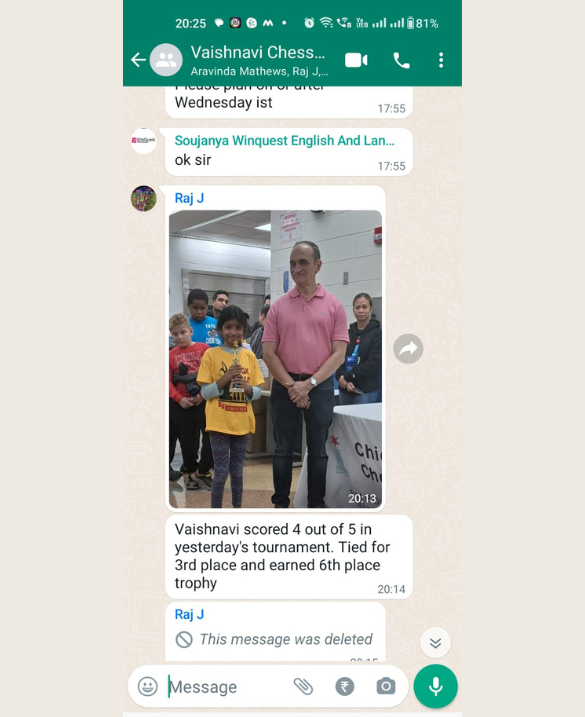
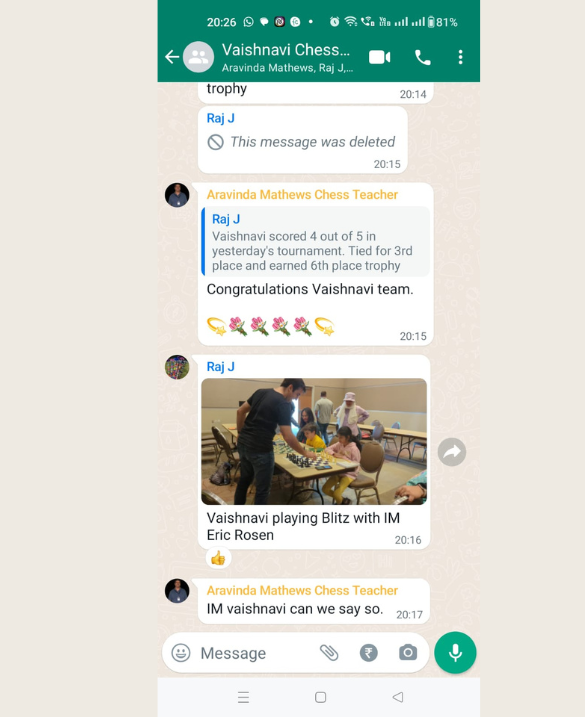
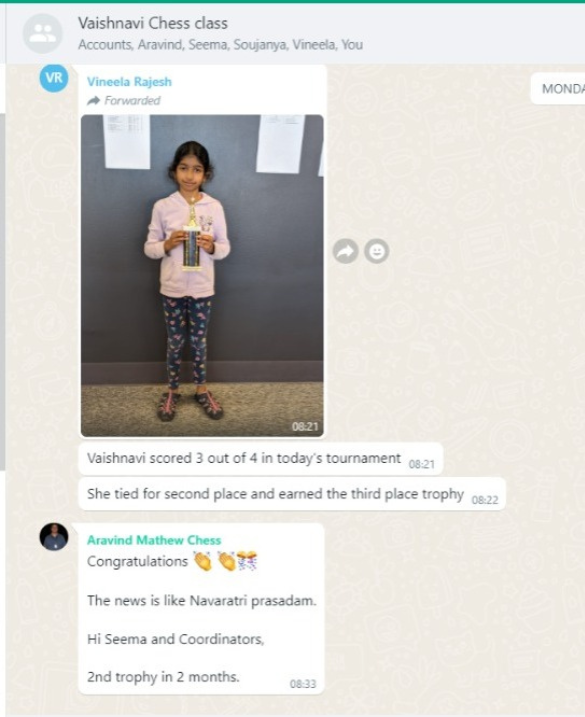
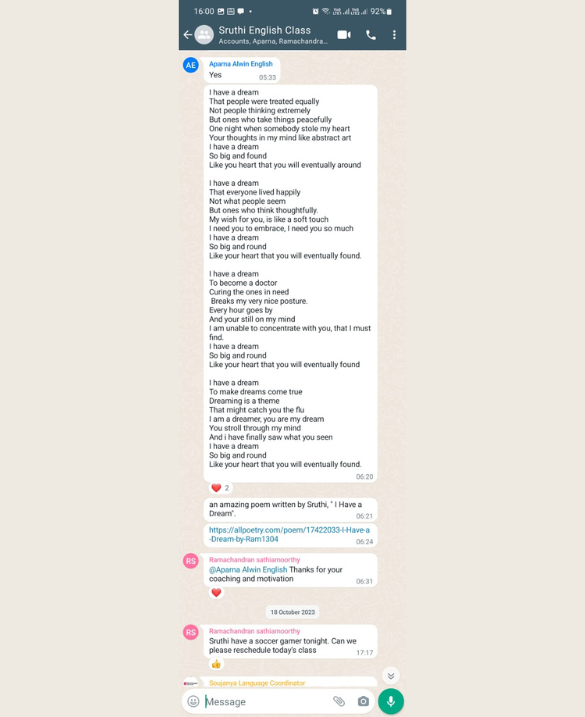
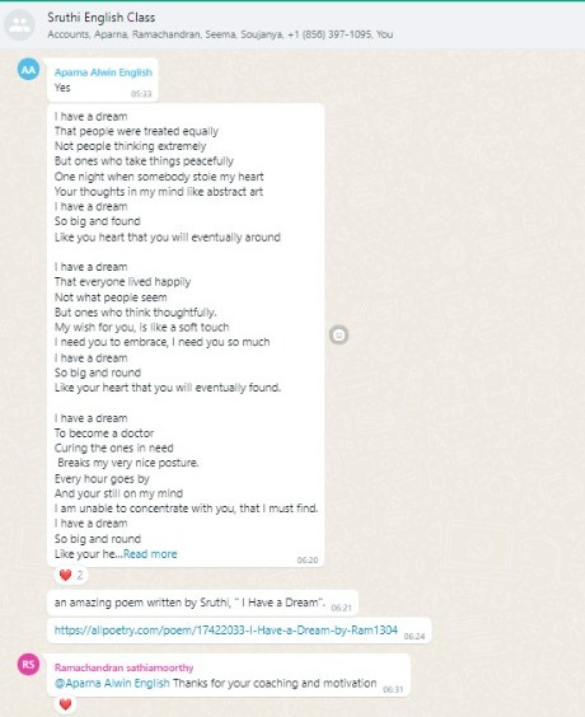
WhatsApp Testimonials
Real Voices from Our WhatsApp Community 💚📚


Latest News and Resources
📰 Learning Updates | 📘 Tips | 🎓 Resources | 💻 Online Courses